
September 2009 Recap
Below is a recap of all the post we've covered in September 2009. If you missed any, or simply want to see them again, click on each "title" to be taken directly to that post. As always, thanks for reading.
Halo 3: Series 1-3
Captain Power and the Soldiers of the Future
Willow
Click "HERE" to go back to the home page.
Willow (Tonka)
Willow
Tonka
1988
Not all toys back in the 80's were winners. In fact if you were to ask me (and I'll concede that nobody has), Willow will go down in my book as the worst one ever produced.

The toys were non posable, unmovable, and came permanently attached to a resin stand making them not even what I would consider to be an action figure. Like I said above, more like miniatures to a roleplaying game that never saw the light of day.
The series saw a total of 14 basic figures, three of which were variations of Willow himself (the third being a Nestle mail away exclusive). The series also included five horseback figures which were essentially a horse with a remolded character from the film. Like the basic figures, the horseback characters were unyielding plastic, leaving not much room to actually play with them, but rather simply as display pieces. But what kid wants to do that with their toys?
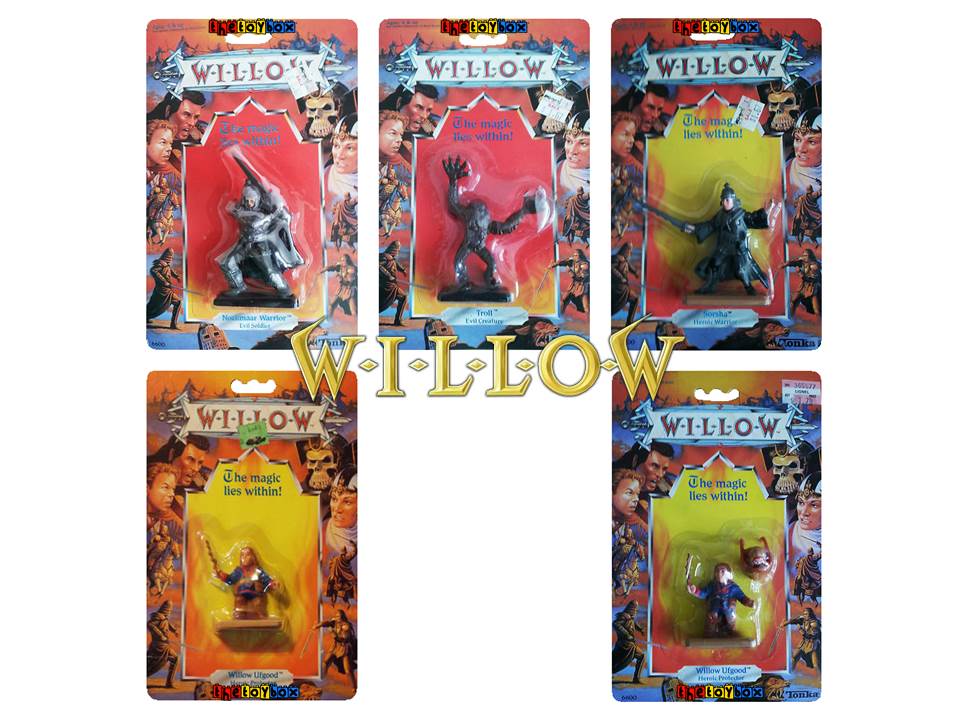
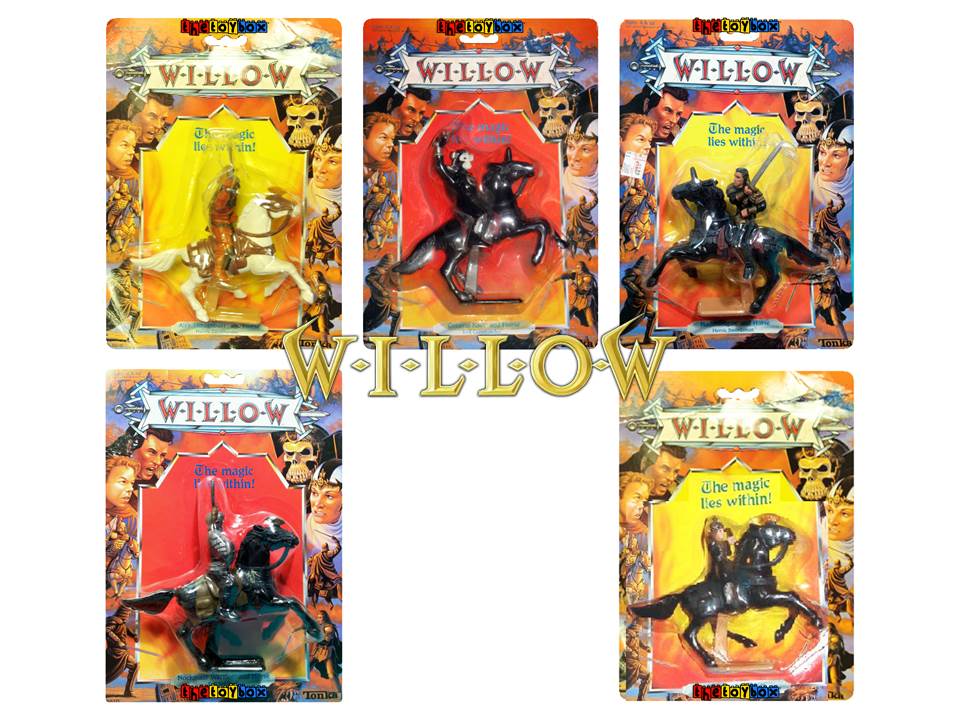

In addition to the single packed figures, Tonka released collector sets which each included two figures and one figure with a horse. Two Hero packs, and one Evil pack have been found by collectors, while a second Evil pack has been noted on several other collectible sites, yet no photos seem to exist, and no physical set has been found on sites such as eBay for purchase.


A large version of the Eborsisk creature from the film was also released with the series. If you were to ask Lucasfilm, their representatives would swear up and down that this toy never hit shelves. This however would be a huge contradiction to the folk who have documented across websites that they do indeed have one, and that they have had it since their parents bought it for them from their local store. So somewhere, someone goofed.


Within what? Certainly not inside the plastic with these terrible toys!
Sorry about that. I get a little sensitive sometimes.

Though the series was short lived, Willow fans across the world still look for the missing pieces to their collection. It may have been one of the 80's worst toy lines, but it's still managed to make it's way into several collector's homes where it remains a cherished part of their collection.

Check back next time when we take a look at another good or bad toy line from the 80's.
Click "HERE" to go back to the home page. For more posts related to this one, please click the labels below.
Captain Power And The Soldiers Of The Future (Mattel)
Captain Power
Mattel
1987
"Power on!"
It's the opening line to every episode of the short lived series, "Captain Power and the Soldiers of the Future."
The series suffered severe backlash from parents who deemed the live action show violent, and containing too many sexual innuendos and implied sexual encounters between characters. Though the show ran for 22 episodes, the typical length of a season for any show, the negative attention it attracted was enough to leave this series stagnant, and while a second season was planned (with an even darker tone), the series was cancelled prior to filming.
The show was initially designed around the toys - Specifically to interact with them, and be incorporated into children's playtime.
Mattel released nine figures in total across two series. Each figure came on its own unique card which highlighted the character in a drawing on the right side of the package.


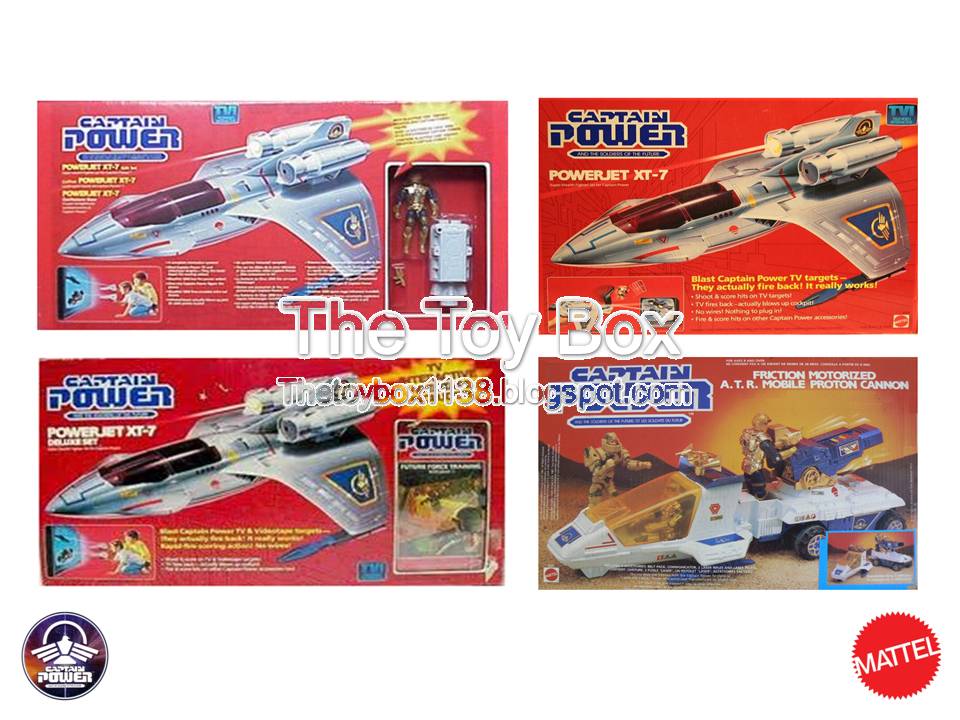
Like Lazer Tag, Captain Power used the premises of light gun technology. But, rather than using actual light guns, your weapons were the fighter planes, and various other vehicles, which you could either attack the other toys with, or shoot at the TV screen during either the live action show or animated show. Your fighter would rack up points as you hit various targets.
But, here's the catch. The targets on screen shot back. This too would register on your plane. Take too many shots and your pilot is ejected from the cockpit with a game over sound.


The show initially started out as a three volume animated series, all of which were available only on VHS. Each cassette was designed to be more challenging than the last, with the very first being specifically entitled as a "training mission".
When the series was turned into a live action show, five more VHS volumes were produced and released. The five VHS tapes contained two episodes per tape, for a total of ten episodes.
In 2011, the complete live action series was released on DVD. As a whole, and from an adult's perspective, the series wasn't bad. It just wasn't designed for children. While it's true that none of the producers of the series ever claimed it to be, the fact that it was based off of a children's toy, and designed to interact with them didn't do anything to attract a more mature viewer.
Captain Power was unfortunately a misunderstood, confused about its audience, toy and series that never found its nitch. For what it's worth though, the toys were incredibly fun, and to collectors are a cherished piece of their childhoods, even if they didn't understand the content of the show.
Click "HERE" to go back to the home page. For more posts related to this one, please click the labels below.
Halo 3: Series 1 - 3 (McFarlane Toys)
Halo
McFarlane Toys
2007 - 2008
McFarlane Toys, a subsidiary of Todd McFarlane Productions, Inc., is a company started by Todd McFarlane that makes highly detailed models of characters from movies, comics, musicians, video games, and sport figures. Founded in 1994, the company was originally dubbed "Todd Toys," but the name was changed in 1995 following pressure from Mattel (who feared the new company's name would be confused with that of Barbie's younger brother).
Exquisite attention to detail is the most defining feature in a McFarlane Toy. However, it is almost always at the expense of articulation, making them more akin to semi-poseable statues than action figures. Still, the line proves popular especially among young adults, and is arguably the most commercially successful toy line at the moment. It has also influenced many other toy lines to try and imitate McFarlane Toys' style.

As production begins on the upcoming series five and six toys, I thought we'd take a look at the first three series which burst on the scene in 2008.
Each set is broken up into two categories. The first being "Campaign", which focuses on characters that the player of the game used in the campaign version, and "Multiplayer", which as I'm sure you can guess at this point is based on characters one can use in multiplayer mode. Because the multiplayer characters vary in color and design, this left McFarlane toys quite a bit of artistic freedom to make a wide variety of characters.

The first series comprised of five campaign figures (six if you include the variant Grunt figure), and six multiplayer figures, three of which were exclusive to specific vendors (two at Walmart, one at GameStop). The silver Gamestop Spartan is by far the hardest to come by from series 1.
There were also three variants produced for the series. These figures were not a part of the Capaign or Multiplayer line, but rather stand alone figures. Each one was available via a different store or means. Most notable is the "Spawn Faced" Spartan which was limited to only 3000 pieces.


By series two, Halo 3 mania had caught on big time. Not only was it the top selling game at most retail outlets, but fans couldn't get enough of the toys that McFarlane Toys were busy pumping out in mass quantity.
Series two featured five figures from the campaign line, and ten for the multiplayer line. However, by this time in the series, the majority of the multiplayer figures were made to be exclusives for various retail and online stores. Places like Transworld (online store only), Toys R' Us, Walmart, D&R Line-Ups (online store only) and GameStop all had an exclusive figure (with the exception of Walmart, which had two) to keep fans running around from store to store to track them down.
An additional figure was also produced as a San Diego Comic Con exclusive for the year.


With each series came more figures, and more exclusives, and series three was far from exempt, being the largest series to date.
A total of six campaign figures and eighteen multiplayer figures were produced. This of course meant even more exclusive figures to chase down.
At this point in the toy line, I can personally attest to it getting out of control. People I know who are die hard fans of the series began to take a step back and frown at all the various exclusive figures. This in turn caused them to take a little more cautioned approach to collecting the toy line, and even abandon it completely.


But, despite the very few people I know who were no longer contributing their twelve to twenty bucks per figure, the series plowed through the market, selling out in most retail and exclusive online chains. With series four already out on store shelves, and selling like hotcakes, and series five and six gearing up for release, it's a safe bet to make that McFarlane's Halo 3 toys are going to be around for a while.
Click "HERE" to go back to the home page. For more posts related to this one, please click the labels below.
August 2009 Recap
Below is a recap of all the post we've covered in August 2009. If you missed any, or simply want to see them again, click on each "title" to be taken directly to that post. As always, thanks for reading.
Thundercats
Microsoft Xbox
The Nintendo Entertainment System
Click "HERE" to go back to the home page.
Nintendo Entertainment System (AKA NES) (Nintendo)
Nintendo Entertainment System (AKA NES)
Nintendo
1984 - 1995

It was 1983. The game market had officially crashed leaving the future of video games looking incredibly bleak. Atari had so many cartridges returned to them from merchants unable to sell them that they literally began burying them in Texas. To this day you can still find sections of the Lone Star State to unearth that would yield to a plethora of games. Granted, they probably wouldn't work anymore.
Despite the market's downfall, Nintendo of Japan made a bold move and decided to release the Nintendo Entertainment System in the United States. The year was 1984. Merchants were very leery about the prospect of stocking any Nintendo items. But, something about the Nintendo made them change their minds. Perhaps it was the sleek look that made the system appear more like home video equipment than your average video game console. Perhaps it was the strong following of games that was slowly but surely building in the local arcades. Whatever the reason the local department stores had for changing their minds, it's clear to this day that it was one that paid off.

Nintendo struck hard in 1984 with two consoles. The control deck which was known as the basic system was available for $199.00. The box included the system, two controllers, and Super Mario Bros. Out of the two systems, it was the higher selling model, and eventually lead to the format that future Nintendo's were released.
The second model was the deluxe version which included not only Super Mario Bros., but the game Gyromite and the play along droid, Robbie the Robot. While it was still a great bundle, the $249.99 price tag often times meant that folks would buy the less expensive version - Thus leading to the overall popularity of the Control Deck over the Deluxe Edition.
There were thirty games available with the initial release of the Nintendo. These games were released in the infamous "black" boxes, a style that was never repeated again. The games were instant classics, and to this day remain among the highest sellers throughout the lifespan of the Nintendo Entertainment System. The games were; 10 Yard Fight, Balloon Fight, Baseball, Clu Clu Land, Donkey Kong, Donkey Kong Jr., Donkey Kong Jr. Math, Donkey Kong 3, Duck Hunt, Excitebike, Golf, Gunshoe, Gyromite, Hogan’s Alley, Ice Climber, Kung Fu, Mach Rider, Mario Bros., Pinball, Popeye, Pro Wrestling, Slalom, Soccer, Stack-Up, Super Mario Bros., Tennis, Urban Champion, Volleyball, Wild Gunman, and Wrecking Crew.


Throughout the late 80's, the NES enjoyed tremendous popularity, blowing all the other systems away and playing a prominent role in the lives of many American and Japanese adolescents. Nintendo ruled over its empire with an iron fist, heavily controlling advertising, distribution, production, and pricing. Retailers that sold unlicensed games or charged lower prices were threatened or had their shipments withheld. Their tactics led to many lawsuits and investigations by the Federal Trade Commission.

Some of the more note worthy lawsuits included Nintendo vs. Blockbuster Video where they sued Blockbuster and won for copywrite infringement when Blockbuster was found guilty for copying instruction booklets for game rentals. Another was when the State of New York sued Nintendo for a monopoly on the video game market. This was attributed to Nintendo forcing all game designers they signed with to sign off that they would not produce games for any other video game system until the contract expired. The State won this case, and Nintendo was forced to release these contracts as well as pay all game owners damages in the amount of $5.00 each. There were several other lawsuits that Nintendo won and lost over the years, but none as note worthy as the two above.
Over the years of Nintendo’s reign at the top of the video game mountain there were several various combinations of the Nintendo Entertainment System released. This included the Action Set which became the most purchased, and most popular among gamers. The Action Set included the renowned Super Mario Bros./Duck Hunt combo as well as the best light gun in the gaming world to date, The Zapper.

Nintendo hit a lull in the late 80's when parents went on a rampage against the company. The complaint - Their children were growing obese because rather than being active, playing sports or simply running about they were glued to the tube. Nintendo responded with the Power Set. A re-release of the Nintendo Entertainment center packed with the Power Pad. This set also included a triple cartridge which contained Super Mario Bros., Duck Hunt and Track and Field.
The Power Pad was designed to keep kids active while playing, and included several sports related games from Track and Field to Nintendo Fitness. It was a huge success, but alas, it didn't promote diet and exercise as parents had hoped, and Nintendo once again fell under attack from parents eager to blame someone else for their kids problems.
Nintendo continued on through the first half of the 90's and released two more versions of the original style Nintendo console. The Sports Set introduced gamers to a whole new way to play games. It included the Nintendo Satellite which allowed for up to four players to play at the same time. A concept never before heard of on a home gaming system. Also included were the twin cartridge Super Spike V Ball and World Cup. The system sold fairly well, but most who desired to own a Nintendo already had one. While sales were acceptable, they were far from what Nintendo would have liked.
The other set released was the Basic Set. It contained everything a person would need to play, except for any games. Needless to say, this was not a popular seller.

In 1991 Nintendo announced that it would produce the Super Nintendo. This was in response to the release of the Turbo Graphic 16 and Sega Genesis making names for themselves on the market. Though despite their better graphics, the sales of the NES and its titles were not deterred. Nintendo simply made the switch to keep current with the times, and not out of necessity.
In 1993 Nintendo released one final packaging of the Nintendo Entertainment System. Dubbed the NES2, this remodeled version did away with the zero gravity feed for the game cartridges and replaced it with a top loader which made the games more likely to respond when being turned on as opposed to the fight it would take with some of the older models. The NES2 also included an updated controller which resembled the style of the Super Nintendo's. No game was included with this pack either, but the $49.99 price made several people eager to do away with their older models and replace them with the NES2.
Speaking of controllers, the Nintendo made some controllers that to this day remain among the best controllers ever produced in the gaming world. The most famous is the Nintendo Advantage, a large arcade style stick which included oversized buttons as well as turbo buttons which could be adjusted for speed with dials. The controller was incredible, and became a fan favorite.

The Nintendo Max was also released around the same time as the Nintendo Advantage. The Nintendo Max was shaped sort of like a boomerang, and did away with the standard cross haired controls and replaced it with a disc. Also included on the controller were the addition of turbo buttons. Personally, we found the Nintendo Max to be difficult to use, and a little over responsive. This made things like staying down when ducking near impossible.
Not officially licensed by Nintendo, the Power Glove became a great novelty for rich kids to show off. But, alas, a novelty was all it ever was as it was unresponsive, and incredibly difficult to use. Mattel released booklets with the Power Glove that included codes that needed to be entered in when playing specific games. This would in turn make the "controller" compatible with the game. When the popularity of the Power Glove picked up, Nintendo opened up to the concept and not only did they give their blessing, they featured it in the 1987 movie "The Wizard" starring Fred Savage - The Wizard in turn turned out to be nothing more than a 90 minute commercial for the upcoming Super Mario Bros. 3.
Nintendo also gets hats off for making the first and only controller for disabled children (and adults). The controller fit around the chest like a vest and included voice activated controls as well as a directional pad which was controlled with the player's chin. This controller was only available by contacting Nintendo directly and requesting it.
Several other accessories were released for the Nintendo between 1984 and 1995. They included the Miracle Piano which was hyped as the easiest way to teach your children piano, and several accessories which were designed to enhance the gaming experience. Other various items such as cleaning kits and plastic storage cases were also readily available.

To help sell its products, Nintendo published its own magazine entitled, "Nintendo Power". In this magazine, kids were treated to a look at upcoming games, reviews of previously released ones, cheat codes, and all sorts of video game articles and pictures. It was a great magazine for its time, and is still published today, adapting with each new console released. The first issue of Nintendo Power made its debut in July/August of 1988.
But, that's just the consoles, controllers and accessories. The real popularity of the Nintendo Entertainment System lied in the games. Well over 800 games were released in the eleven years that Nintendo ruled the gaming world. If one were to add in all the unlicensed and foreign games there would be close to 1000 of them. You could always tell the difference between a licensed and unlicensed game by the official Nintendo brand seal of approval being present (this was the same for consoles and accessories as well). And with out further delay, here are all the licensed games for the Nintendo Entertainment System...


Despite all the games Nintendo released, none would ever sell more copies than The Legend of Zelda. It was the first game in history to sell over one million copies, and to this day remains one of the most famous games in the world. Also worthy of noting is the game Sesame Street: Big Bird's Hide and Speak. This unexpected game pushed the limits of the Nintendo by becoming the first Nintendo game to include voice over acting.
Nintendo had learned from the mistakes of its predecessors, and instituted a very strict licensing system for third-party game developers. This helped prevent the over-saturation of the software market which had brought about the '84 crash.
Although Nintendo had a strict licensing policy , many games were merely mediocre clones or crappy licensed games. Nintendo's "Seal of Quality" wasn't a measure of how good the game was, the seal just meant that the company had paid a licensing fee and that the game didn't contain adult content. Nintendo censored all U.S. releases, removing questionable words or adultish content. While this protected Nintendo's image, it effectively alienated it’s over 13 (years old) market.
Nintendo also had strict third-party programming policies for many years (and as mentioned above, were sued for a monopoly because of this): if you programmed for Nintendo, you only programmed for Nintendo. This policy helped kill off most of the NES's early competitors, like the Sega Master System. Companies were also limited to releasing two games a year, and Nintendo manufactured all NES cartridges themselves to control production. This hurt them greatly during the 1988 chip shortage, and the practice was discontinued in 1990. Those types of policies were later changed due to government pressure.
Tengen, a subsidiary of Atari Games and former Nintendo licensee, announced in 1988 that it had bypassed Nintendo's "lockout chip" and planned to manufacture and distribute its games independently. The lockout chip was Nintendo's method of controlling what NES-compatible games were manufactured. They were followed by several other "pirates" who produced several games over the years. Due to legal loop holes, these companies were able to produce games for the Nintendo without any threat of suit, and also without having to pay Nintendo a licensing fee.
Here are all the known unlicensed Nintendo games;


Nintendo also released a handful of multi cartridge games. These cartridges contained two to three games per cartridge, and were packaged in with the various console releases.
The games came with a black Nintendo sleeve, but no box, and were typically form fit into the Styrofoam packaging inside the console box.
These are the only four known multi cartridges that were produced.

As popularity of the Nintendo Entertainment System grew, Nintendo held/sponsored a worldwide championship in 1990. For this, they produced very limited cartridges which contained portions of games, and a timer.
The objective of the competition was to get the furthest, as well as the most points as all the competing players, all while a clock was ticking down.
With the world of the internet, these cartridges, while few and far between, have made their way into collector's homes, though at an expensive price. One cartridge can fetch ten to twenty thousand dollars.
It is unknown how many of the grey cartridges, which were used in the competition, actually exist, but it is confirmed that 27 of the gold cartridges exist as these were the prizes (along with $10,000 cash) which were handed to winners.
When the Nintendo Entertainment System finally reached the end of the line in 1995, Nintendo decided to retire the system with a bang by showcasing a brand new villain for it's front man and spokes face, Mario. Wario's World was released not only on the Nintendo, but on the Super Nintendo and was so well received that the character has had several games produced based on him.
Today, the Nintendo Entertainment System has been sold to over 60 million buyers, and over 500 million cartridges have been sold world wide. The system and all its games remain an iconic staple in the world of electronic entertainment, and will forever be remembered as the system that rekindled the world of video games.
Click "HERE" to go back to the home page. For more posts related to this one, please click the labels below.
Subscribe to:
Posts (Atom)