Thundercats (LJN)


Thundercats
LJN
1985 - 1987

Thunder
Thunder
Thundercats! Hooooooooo!

Thundercats was one of the biggest hit cartoons of the eighties. A cartoon which contained futuristic technology and alien worlds, merged with the fantasy of ancient evil and monsters. This show was close but quite different than He-Man and still remains a favorite amongst eighties nostalgic collectors.

Following up the 130 episodes was an incredible line of toys produced by LJN. The figures stood at an average of 5 inches tall and represented each character from the series better than any toy line for its time. LJN produced 3 main series of figures, with three sub series. All cast characters of both good and evil were produced. This would include the honorable Thundercats team to the vile Mutants and Mumm-Ra, and also included many characters that appeared in anywhere from one to all of the episodes.

LJN did not hold back on their extreme detail of sculpting, allowing each figure to look exactly like the character from the show. Almost every figure had a "Battle-Mattic" action feature which was basically a lever in the back which when pressed the figure would move their arm or other various body parts. Other figures had options of spinning or lighting up.

Probably the biggest mistake that LJN made when producing the Thundercats toy line was that they produced the entire main cast (both good and evil) in the first series. While fans were happy to gobble them up from retail stores, this left little to no reason to purchase anything past this series unless you were a die hard fan of the show and easily recognized all the obscure figures that would follow.

The first series of Thundercats included;

Lion-o
Tygra with Wilykat
Cheetara with Wilykit
Cheetara
Panthro
Tygra
Mumm-Ra
Jackalman
Monkian
S-S-Slithe

Each figure came with accessories and weapons that were dead on to the original show. This made it even easier for children to incorporate the toys into their imaginations based on what they were already very familiar with. Interesting was that Tygra was sculpted to resemble his younger version as seen briefly in the very first episode of the series.

Hot on the heels of the first series was the inevitable second. An additional seven figures were produced which included a newly sculpted Tygra that more resembled the character portrayed in the cartoon. Several figures from the first series were repackaged for the series, and all the cards included a mail away offer sticker at the bottom right corner.

As we said above, the second series (and each additional series) was not as popular as the first. While it contained some known faces, one had to be quiet a fan of the series to recognize all of them.

The new figures produced were;

Lion-O with Snarf
Tuska Warrior
Snowman of Hook Mountain
Hachiman
Mumm-Ra with Ma-Mutt
Grune the Destroyer
Ratar-O
Vultureman

Ratar-O was produced with both black and silver weapon variants.


When the final season of the Thundercats cartoon aired, several new faces were introduced in hopes of reviving the series for further episodes. This included creating a whole new story arch which included a second group of Thundercats stranded on the same planet. These characters were eventually found by the original Thundercats and invited to join the already crowded Cat's Lair.

The third and final series of Thundercats included;

Jaga
Ben Gali
Lynx-o
Pumyra
Mongor
Safari Joe
Captain Cracker
Captain Shiner

During the second series of figures, LJN produced a few sub sets. One of these subsets included "Companion Packs".

Companion Packs comprised of seven smaller figures from the series (four of which were previously available with the larger figures), but were newly sculpted to better represent the characters on the show.

The Companions Packs included;

Wilykit
Wilykat
Snarf
Ma-Mutt
Berbil Bill
Berbil Belle
Berbil Bert

Another sub series which hit shelves were the four Berserkers. Each Berserker came individually packed in a much larger carded bubble than the original figures and boasted some pretty fancy upgrades which included spinning action and rev up and go.

The Berserkers were introduced late in the series in an attempt to shift the focus off of Mumm-Ra who was getting to be a very tired out villain. They were basically a group of sky pirates bent on pillaging and stealing, and mainly took out their aggression on the Berbils.

The four Berserks released were;

Hammerhand
Ram Bam
Top Spinner
Cruncher

The third and final sub series released, which came out during the third series of toys were the Ram-Pagers which consisted of Driller, and The Stinger. A third Ram-Pager, Mad Bubbler was slated for release, but the series was cancelled prior to production.

As with most toy lines, LJN offered an exclusive mail-away figure of Mumm-Ra as a mummy. This figure was available between the second and third series by mailing in a set amount of proof of purchases as well as a small shipping fee. The figure was mailed in a plastic bag inside of a plain brown box and came with a staff.

With the exception of his arms being able to go up and down, the figure was a solid piece of plastic.

Most of the vehicles available in the Thundercats line were seen in the show, but there were a handful of them created by LJN specifically for the toy line. Obviously the more highly sought after ones by kids were the Thundertank and Cat's Lair as those were seen daily on the show.

The vehicles included throughout the entire Thundercats line were;

Thundertank (first series)
Mutant Skycutter (first series)
Mutant Nose Diver (first series)
Thunderclaw (second series)
Hovercraft (second series)
Mutant Fistpounder (second series)

Two creatures were also produced for the series; Tongue-A-Saurus (third series) and Astral Moat Monster (first series).


Two playsets were produced for the series during the second series of toys; The Cat's Lair and Mumm-Ra's Tomb Fortress.


During the third series, LJN produced a small line of accessories, the Lasersabers. They were essentially four of the same backpack, but in various colors;

Blue
Black
Red,
Orange

Red is the hardest to come by, and all are fairly difficult to find mint in their packages.

A final set of toys released in the third series was known as "the transporters". These included;

Luna-Lasher
Thunderwings
Stilt Runner

The Thunderwings and Luna-Lasher were also released on bubble packages with Lion-O (packed in with Thunderwings), and Mumm-Ra (packed in with Lunar Lasher). They are incredibly hard to find.

LJN had planned many more figures and pieces to be produced. These unproduced prototypes were so close to production, that they were even featured in catalog inserts with the toys.

We remember Thundercats fondly. Right along side He-Man, it was one of our favorite cartoons growing up.

Click "HERE" to go back to the home page. For more posts related to this one, please click the labels below.

July 2009 Recap


Below is a recap of all the post we've covered in July 2009. If you missed any, or simply want to see them again, click on each "title" to be taken directly to that post. As always, thanks for reading.

GoBots
Battle Beasts

Click "HERE" to go back to the home page.

Battle Beasts (Hasbro)


Battle Beasts
Hasbro
1986

For those true children of the 80's, Battle Beasts should ring a bell. They were small one inch tall figures released by Hasbro in 1986. Each Beast had a heat sensitive sticker on their chest. When rubbed, it would reveal if the Battle Beast was Fire, Wood or Water. It was advertised that fire Beasts could beat wood Beasts, wood Beasts could beat water Beasts, and water Beasts could beat fire beasts.

Between 1986 and 1987 Hasbro released a total of 76 different Battle Beasts over three separate series. This started with Pirate Lion (#1) in series one, and ending with Ossified Orangutan (#76) in series three. The series also spawned a handful of sub series, but most were never released in the United States.

The series originate in Japan, and was initially a tie in to Transformers. Some of the characters from Battle Beasts even made appearances in the Japanese Transformers Head Masters TV show. However, the two were never associated in the United States.


For the first and second series, the figures came packed in random two packs on bubble cards. This made collecting a full set incredibly difficult to do, while at the same time avoiding duplicates.

The first Series of Battle Beasts contained 28 figures. Each figure was individually numbered on its back, and carried a unique weapon which ranged in color from silver, to bronze to grey. However, the names of the characters were anything but unique, and were often times as uncreative and cliché to the character they were attached to.

Series one include; Pirate Lion, Deer Stalker, Ferocious Tiger, Colonel Bird, Killer, Carp, Triple Threat Snake, Horny Toad, Sledge Hammer Elephant, Rocky Rhino, Roamin’ Buffalo, Grizzy Bear, Blitzkrieg Bat, Gargantuan Gorilla, Swiny Boar, Gruesome Gator, Sly Fox, Hardtop Tortise, Rubberneck Giraffe, Prickly Porcupine, Sawtooth Shark, Danger Dog, Hare Razing Rabbit, Sir Sire Horse, War Weasel, Bloodthirsty Bison, Bighorn Sheep, Webslinger Spider, and Crusty Crab.

The second Series of Battle Beasts contained 24 figures. These came out towards the beginning of 1987. Like the first series, each figure was individually numbered (picking up where series one ended) and carried a unique weapon which ranged from gold to bronze colored. Towards the end of the series, the newer figures were updated with new artwork on their chestplate symbols.

Series two included; Icky Iquana, Armored Armadillo, Jaded Jag, Humungous Hippo, Major Moose, Delta Chameleon, Kickback Kangaroo, Octillion Octopus, Wolfgang Walrus, Powerhouse Mouse, Dragoon Raccoon, Antic Anteater, Run Amuk Duck, Minder Mole, Cutthroat Cuttlefish, Eager Beaver, Slasher Sea Horse, Knight Owl, Hunchback Camel, Pillaging Polar Bear, Squire Squirrel, Sabre Sword Tiger, Bludgeoning Bulldog, and Pew-Trid Skunk. As you can see, the names didn't get any better either.

Series two also began the promotion of the Sunburst Warriors. Essentially what it came down to was randomly packed figures that had a new symbol on their chest that was incorporated in the element system. This new warrior was capable of defeating any of the three elements of the other beasts. Rather than produce new figures, Hasbro simply slapped this symbol on prior released figures. The tactic was completely random, and it's difficult, if not impossible, to say just how many different figures received this new symbol.

When series three was produced, Hasbro ceased releasing the figures in two packs, and went for the more direct approach to parent's wallets. Now available as only eight packs (still randomly packed), the figures were highly overpriced (at the time), and the toys saw little movement in sales.

This final "official" Battle Beast series came out during the middle of 1987 and ran through the fall season. A total of 24 figures were released in the third series, each with the same attributes as their predecessors.

The series included; Panzer Panda, Leapin’ Lizard, Killer Koala, Tarsier Tyrant, Black Panther, Torrential Tapir, King Cobra, Manic Mandrill, Pixilated Pointer, Pillager Pig, Rowdy Rooster, Musky Ox, Tangin’ Pangolin, Slowpoke Sloth, Ardent Aardvark, Bodacious Bovine, Zealot Zebra, Harrier Hawk, Diving Duckbill, Crooked Crow, Frenzied Flamingo, Fleet-Footed Antelope, Pugnacious Penguin, and Ossified Orangutan.

Shortly after series three the name "Battle Beasts" was dropped (in Japan) and replaced with Laser Beasts (known as Battle Beasts: Shadow Warriors in America). The figures were also revamped removing the heat sensitive stickers and replacing them with orbs which depicted each individual figures power. Only ten figures from the Laser Beast series ever hit store shelves in the United States, and shortly afterwards, the series fizzled away into the deep, dark pit known as 80's retro.

While numerous vehicles and playsets were produced throughout the entire line, very few saw release on US shores. Out of almost a dozen Battling Chariots produced, only three saw a release in the USA; Battling Big Horn, Battling Deer Stalker, and Battling Tearin' Tiger.

Much like the figures, these were released on bubble cards, but contained a new background for the logo. The words, "Battle Chariot" were also present underneath the logo.

These chariots are incredibly difficult to find these days in mint in package condition. In fact, we dare say it's next to impossible.

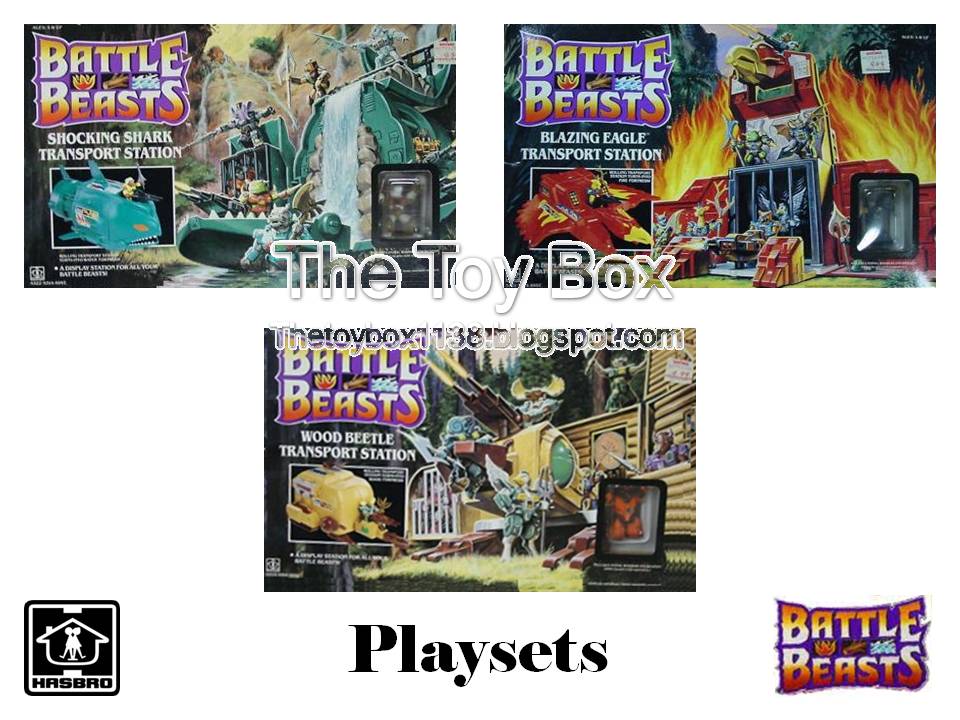
While they're considered playsets, these next three toys actually closer resemble the Battle Chariots.

The Shocking Shark Transport Station, Blazing Eagle Transport Station, and Wood Beetle Transport Station each came packaged in a cardboard box, and contained a unique figure.

Like the Chariots, one was released (in the USA) to represent each element.

The final item to hit US shores was the Bandolier, which was more of a make shift carry case for the figures. It was a relatively unpopular item at the time, and today is a pretty common item on secondary markets.

Opened ones can fetch anywhere from ten to twenty dollars, and mint in box ones don't go for all that much more.

Battle Beasts were somewhat hot for their time. The line certainly had a unique marketing approach by means of not necessarily selling the figures based on who they were, but rather on the secret identity of their powers which could only be identified by purchasing and opening the package. I suppose the lure was more from curiosity as opposed to desire.

While it may not be remembered by many today, it's certain that there are still collector's out there looking to complete their sets from their childhood, or simply rebuild them from scratch. A two pack can fetch as much as one hundred to two hundred dollars depending on the figures inside. That's a considerable mark up from the original retail price which ranged from eighty-nine cents to a dollar fifty depending on the store you went to.

For all you Battle Beast collector's out there, you have an expensive journey ahead of you, and a tough on too. We salute you for your efforts!

Click "HERE" to go back to the home page. For more posts related to this one, please click the labels below.

GoBots (Tonka)


GoBots
Tonka
1984 - 1987

If your family didn't necessarily have a lot of money in the 80's it didn't exclude you from the "Transformers" crazy that hit in 1984. GoBots were the only true rival to the Transformers, and remained so throughout the 80's.

What ended up hurting GoBots the most was the while both they and Transformers had their own animated series, the Hannah-Barbara produced GoBots often came off as less "mature" than the Transformers. Granted kids were watching the series, but facts were that Transformers was just a little more stimulating to the brain.


The GoBots toy line originally began in Japan. The series creator Popy Planning was actually a division of Bandai, which is the well known company behind the infamous Power Rangers. Rather than being called GoBots, the series was called Machine Robo. The story lines and animation were far superior to the U.S. versions, but then again, they usually are.

When Machine Robo finally aired in the U.S., kids went ravenous for the "in" toy line of the 80's. Toys that transformed from robots to cars, planes and other various machinery were like crack cocaine. The series became so popular that like Transformers, a movie for the theaters was eventually released. This springboard gave Tonka the opening that they were looking for, and several other sub series were released under the GoBot logo.

However, we're going to only look at those related to the TV show.

Seventy three standard GoBots were released between 1984 to 1987. Unlike Transformers, the series remained one size, and one size only. Being the equivilant of the smaller Transformer, Tonka somehow managed to not only make the figures more durable, but also managed to include great detail, something sorely missing in it's competator's line.


On top of the 73 standard "figures", Tonka released two vehicles, and two playsets. This was by far impressive when compared to the amount of "figures" that were released, but it kept the series relatively affordable for most lower income families.

As the years pressed on, several sub series hit shelves. This would lead to the eventual downfall of GoBots as oversaturation in the market would eventually catch up. It didn't help that all these additional lines had no show or movie to back them up, thus leaving kids unsure of what they were. The series included; Super GoBots, Combiners, Dread Launchers, Secret Riders, Boomers, Power Marchers and Arco Bots.


GoBots eventually fizzled out in 1987. Tonka pulled the plug on the toy line when the show was cancelled. What's great about this series is that while it was ending once the bug like creatures began hitting the market, you can definitly see where this design style stayed with later Bandai products.

For whatever it was worth, GoBots put up a good fight against the Transformers, but due to marketing strategies and the intelligence level of the show, the series just couldn't hold on.

But, that's our look at GoBots. I hope you enjoyed it. Check back next time for a look at another great toy series from the 80's!

Click "HERE" to go back to the home page. For more posts related to this one, please click the labels below.
June 2009 Recap


Below is a recap of all the post we've covered in June 2009. If you missed any, or simply want to see them again, click on each "title" to be taken directly to that post. As always, thanks for reading.

G.I. Joe 1986
Teenage Mutant Ninja Turtles: The First Two Years

Click "HERE" to go back to the home page.

Teenage Mutant Ninja Turtles: 1988 and 1989 (Playmates Toys)


Teenage Mutant Ninja Turtles
Playmates Toys
1988 - 1989

If ever there was a cartoon (key word cartoon) that inspired and shaped me through my youth it was Teenage Mutant Ninja Turtles. As a child, I always knew that I wanted to be a comic book artist when I grew up. The TMNT show (and eventually the comic) became such an inspiration to me art wise that as the years went by, my goal was to eventually send a portfolio to Mirage Comics (the company where the series was created) and hope like hell that mine out of the hundreds of other portfolios they saw in a day would be stand out. Sadly, this dream got derailed when a couple years after I graduated high school the company went bankrupt and closed down.

But, enough about dreams lost. We're going to take a look at the first two series of action figures in the TMNT world. We're only doing the first two series for a couple reasons. First, they're the only two from the eighties, and second, they're the only two that are actually decent.


While it was already a comic book by the time the cartoons began airing, it wasn't well known for its time, and only had a small following. While you would think that having a highly successful animated show that aired daily would change this, it didn't. This was most likely due to the major differences between the two.

In the show, the four turtles led quirky lives full of (at the time) hip phrases as they battled crazy looking characters from Dimension X. On the other hand, while the comic book had a few of these characters, they were not represented in the same way. The comic had way more edge to it and featured a lot of violence for its time.

In 1988 Playmates was awarded the ability to produce a line of action figures to the highly popular TV series. The set included ten action figures that were accompanied with six vehicles. One being the highly sought after Technodrome.

The series included the following figures; Donatello, Michaelangelo, Leonardo, Raphael, Splinter, April O'Neil, Shredder, Foot Soldier, Rocksteady and Beebop.

***UPDATE***

Reader Matt K. asks an excellent question pertaining to the series.  He asks, "What's the deal with the soft heads vs. hard heads?"

To answer, the soft heads (or squishy heads) are from the very first production run of the series, and were only used for eight of the figures - The Four Turtles, Splinter, Shredder, Beebop and Rocksteady.  This was done by Playmates Toys as a cost cutting measure.  While Playmates was eager to produce a line based on the series, they weren't yet convinced that it would be successful.

When the line found immediate success in toy isles, Playmates stepped up the production value by making the hard plastic heads.

The soft heads are incredibly rare, especially carded, and thus come at a higher asking price.

The vehicles and playsets were; Technodrome, Foot Knucklehead, Turtle Party Wagon, Turtle Blimp, Turtle Trooper, Party Wagon and Cheapskate.


The biggest complaint from kids was the awful decision on Playmates part to package the weapons in the same fashion that they came off the assembly line. Meaning, they were all attached in a rectangular plastic mold (like model pieces), and were difficult to get apart without breaking. Not only were the weapons very fragile, but if one was lucky enough to separate them without any damage, there was still the problem of pointy and/or sharp edges due to remaining plastic bits. Sadly this manufacturing decision didn't change for a while in the series.

By series two in 1989, Teenage Mutant Ninja Turtles was a household name. Halloween saw several young turtles going from house to house as costumes became available, as well as a new comic series which was produced by Archie comics and geared more to resemble the show.

The second series of figures included mainly second stream characters, but still managed to kick out a few villainous main characters.

Series two included the following ten action figures; Casey Jones, Usagi Yojimbo, Ace Duck, Genghis Frog, Krang, Baxter Stockman, General Tragg, Metalhead, Leatherhead, and Rat King.

They were released simultaneously with the following seven vehicles and playsets; Turtlecycle, Retrocatapult, Flushomatic with (sold seperately) Retromuagen Ooze, Double Barreled Plunger Gun, Turtle Pizza Thrower, Footcruiser, and Sewer Playset.


TMNT went off the air long before the actual toy line ended in 1997. The ongoing popularity of the toy line was due in part by the three movies that hit theaters throughout the 90's as well as a brief stint at Pizza Hut (Coming Out Of Their Shells), syndication of the original series, and eventually a new series where a female turtle was added to the group as a new lead character.

However, this doesn't mean that they toys being produced were actually any good. Each series that followed the last seemed to be an excuse to make multiple versions of the turtles with different themes to them. Whether it was sports players, dinosaurs, transforming or other various carnations, the creativeness of the series was certainly gone.

Like so many toy lines before it, Playmates attempted a revival of the series by re-releasing the original first series again in stores with the same packaging back in the early new millennium. This in turn helped spawn interest in the series again, which led to the eventual new movie released in 2007 as well as several more toys that continue to be released today. The TMNT franchise also got another boost when Image Comics purchased the rights to the series and began producing a new (horrible) comic book series.

Playmates may have lost sight a long time ago of what made Teenage Mutant Ninja Turtles the still going pop culture that it is, but despite this, the series created by Kevin Eastman and Peter Larid over twenty years ago continues to etch its name in stone making it a series that has spread across two generations of fans - a feat not easily achieved.

Check back next time when we take a look at a series that was a hell of a lot larger than I thought possible. Considered the "Poor Man's Transformers", they somehow managed to not only be of better quality, but also be available at a much cheaper price. I'm talking about GoBots of course. See you then!

Click "HERE" to go back to the home page. For more posts related to this one, please click the labels below.

G.I. Joe: A Real American Hero 1986 (Hasbro)


G.I. Joe: A Real American Hero
Hasbro
1986

While it wasn't known at the time, 1986 was the beginning of the end of G.I. Joe - Even though the series continued on for another decade. In this year, Hasbro began what would become a staple in the line. They began repainting figures and re-releasing them in mass abundance, and in various separate subsets. This concept would continue on until the series finally ended. This concept also wouldn't be limited to the figures themselves, and eventually the vehicles got the same treatment.
A total of 32 figures were released in 1986. Seventeen grunts, five Special Missions: Brazil figures, nine vehicle drivers and one new mail away figure.

The seventeen grunts included; B.A.T., Beachhead, Dial-Tone, Dr. Mindbender, General Hawk, Iceberg, Leatherneck, Lifeline, Low-Light, Mainframe, Monkeywrench, Roadblock, Sci-Fi, Viper, Wet Suit, Zandar, and Zarana.

The five Special Missions: Brazil figures - Which were simply repainted figures which had previously been released were; Claymore, Dial-Tone, Leatherneck, Mainframe, and Wet Suit.


Accessory Pack #4, also known as Cobra Battle Gear was released with this series.
The nine vehicle figures which were only available with their respective rides were; A.V.A.C., Cross Country, Lift-Ticket, Motor-Viper, Serpentor, Sgt Slaughter, Slipstream, Strato-Viper, and Thrasher. While not mentioned before, it's worth noting that most vehicle drivers were never available individually on cards. A handful were offered (in repainted formats) here and there, but usually via mail-away offers (I.E. Sgt. Slaughter).

Speaking of mail-away figures. The mail-away figure this year was The Fridge - An actual football star of the 80's.


The 1986 series saw a handful of pretty cool vehicles (for their time). The vehicles included; Air Chariot, Conquest X-30, Devilfish, H.A.V.O.C., Hydro Sled, L.C.V. Recon Sled, Night Raven, STUN, Terror Drome with Firebat, Tomahawk, Triple T, Accessory Pack #4, Dreadnok Air Assault (Sears Exclusive), Dreadnok Ground Assault (Sears Exclusive), Swampfire, Thunder Machine, L.A.W., Outpost Defender, and Surveillance Port.

The Night Raven and Terror Drome would be the most sought after in this set, and today still fetch a pretty penny from collector's looking to complete their sets.


So, where are we at here? Let's see, we're in the 1986 series, and still the Joes outnumber the Cobra's with 65 versus 36. Boy it's a good thing that Cobra had an unlimited amount of soldiers versus lead characters or they'd have been screwed worse than they already were. As far as fire power, the Joes have a whopping 52 as compared to the Cobra's 31. Well, at least the Cobra's got the base again.

But, that about does it for the 1986 year. G.I. Joe dominated the market for many more years to come. I plan on taking you through 1989, but after that our journey through Joe Land will come to an end.

However, before we get there, join me next time when we take a look at another dominating toy line of the 80's which like G.I. Joe is still running strong today. I'm talking about Teenage Mutant Ninja Turtles. They're the heroes in a half shell. TURTLE POWER!

Click "HERE" to go back to the home page. For more posts related to this one, please click the labels below.