Sega Master System (Sega)


The Sega Master System first debuted in 1985 in Japan, and later in North America (1986) and Europe (1987). It was to be come the first contender to step in the ring with Nintendo for dominance during the home console war.

Unlike the Nintendo Entertainment System, the Sega Master System could play two types of games; cartridge based, and thin "credit card" based. The thinner "credit card" based games were generally cheaper at retail, but were also typically simpler designed games due to the inability to store a high capacity of information. The system was also compatible with a light gun, and featured 3D glasses for use with specifically coded games.

Probably one of the most unique things about the Master System was that the console itself contained games that were built into the system - known as BIOS. These games could be played when a cartridge or card was not inserted into the system. Depending on what model of the console you bought would determine what games were built in.

The system found the most success in Europe where it actually beat Nintendo as the highest selling console. However it failed to nick the surface in Japan and the USA. This was in part because of the monopoly that Nintendo was hard at work creating. In its contracts, Nintendo forced third party game developers to produce games exclusively for their system, and levied heavy fines against any who tried to stray from this. Out of this fear to breach contracts, and lose any potential status with Nintendo, Sega was left picking the scraps up from designers and developers who could get, or didn't want to be in with Nintendo. As a result, there are a larger majority of what gamers consider to be "poor" games for the Sega Master System as compared to the Nintendo Entertainment System.

However, this was not the whole reason why the system failed in the USA. The majority of the blame falls on Tonka who was licensed to market the system in America. As a toy manufacturer, Tonka reps had no experience in marketing video game consoles, and as a result they did so very poorly. With displeasure in Tonka, when it came time to release their follow up console, the Sega Genesis, Sega took matters into their own hands, and marketed the system themselves.

There were also far less games for the system. While Nintendo had almost (if not more than) a thousand games, the Sega Master System's catalog is only a few hundred. Considering how strong the system sold in Europe from 1987-1996, that's not a whole lot of games produced when compared to the time frame. It didn't help that months would go by without any major releases from developers.

While over the course of its time the Sega Master System saw many console variants such as the Mark III, Master System II, and Master System 3, the most notable is the 2006 handheld version which was distributed in the USA by Coleco. It didn't necessarily make the games better, but had a strong nostalgic following.

In 2009, the Master System was voted as the 20th best console (out of 25) - Quiet a slap in the face considering that the prior generation consoles Intellivision ranked in at number fourteen, the Colecovision ranked in at number twelve, and Atari 2600 came in at number two. We'll let you guess who number one was on that list.

Now join us as we take a look at every single game produced for the Sega Master System;


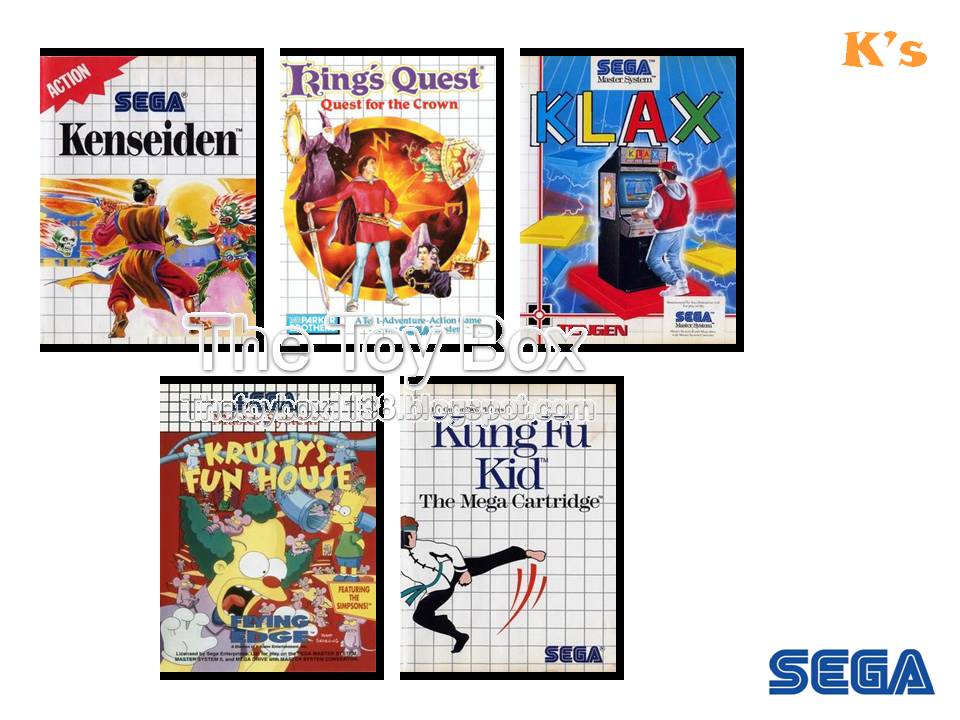


Yes, the Sega Master System lost the fight, but for what its worth, it stands as the first true challenger to Nintendo, and with the release of their next console, the lines in the sand was drawn even wider, and while the war had started, a true battle was on the horizon.

Join us next time when we take a look at The Adventures of Batman and Robin!

Click "HERE" to go back to the home page. For more posts related to this one, please click the labels below.

Geoffrey T. Carlton - Star Wars Super Collector's Wish Book


When it comes to collecting Star Wars, the hobby can span to anything humanly possibly. Toys, plates, jars, buttons, anything! If it exists, rest assured someone is collecting it. But where does someone new to any hobby turn when they're looking to amass the ultimate collection?

A great resource that we've found is the Star Wars Super Collector's Wishbook by Geoffrey T. Carlton. Since the first edition, Geoffrey, or Todd, as he's known to his friends has been amassing the ultimate visual guide to every Star Wars collectible in the world. Along with his dedicated Super Contributors, each volume, in the now six volume series, only gets bigger and better.

We caught up with Todd in a rare quiet moment in his daily routine of researching Star Wars items around the world to chat about his incredible series of books. We learned about how it all began, where it's going, and most importantly, just how much time it takes one person to compile a massive tome of Star Wars collectibles from around the world in one book.


THE TOY BOX: Thanks for giving us this opportunity to talk about your amazing series of books. We’ve been big fans since the first edition, and even bigger fans since personally contributing to the 3rd and beyond.

GEOFFREY T. CARLTON: Thank you for reaching out to me. The books wouldn’t be nearly as impressive if experts like you didn’t volunteer to fill in the areas that I don’t specialize in myself.

THE TOY BOX: Tell us about the first time you saw Star Wars. What went through your head, and how did it change your life?

GEOFFREY T. CARLTON: In 1977 my older sister was heavily into Breyer horses. During summer vacation from school she got permission from Dad for us to go to the movies. All day long she kept teasing me that we were going to see "Star Horse". As a 10 year old little brother, I absolutely refused to the point that I threw a kicking fit over it (I lost). We were so amazed by the film that we stayed in our seats and watched a second showing. We got into trouble for coming home late for dinner without calling. I had noticed the silver droid in the opening scenes the first time we watched it. The second time we watched it I was so enthralled I forgot to watch to see where the robot disappeared to. We went back the next Saturday to see it again just so I could see where that droid went. The next time we went we made Dad go with us. Star Wars sneaked up on us as a force to bind the family together.

THE TOY BOX: What could possibly posses a man to say, “I want the never ending task of cataloging EVERY Star Wars item ever made.”

GEOFFREY T. CARLTON: Hmmm. I don’t know that I’ve ever said that, either to myself or out loud. Twenty-five years ago I had three lists. “Star Wars toys I have,” “Star Wars toys I want”, and my “Star Wars wish list.” The wish list was a combination of things I had heard of but would never be able to find or afford and things that it was a shame that nobody ever produced. Two of my biggest wish list items were LEGO sets and PEZ dispensers. Back then (1988) Star Wars was pretty much dead and gone. It was tough to even find the figures at garage sales in the small town I lived in. Those three lists combined were eventually the foundation for the Star Wars Super Collector’s Wish Book, every item I had, plus those I learned about and was actively seeking.

As far as cataloging everything goes, that came from a spark I caught when I realized the 1997 Tomart’s price guide (still my favorite) was ‘huge’ but missing a several items both on my wish list and in my collection. I started comparing them and the more I dug around, the more items I found that were missing from the book and from my own lists. The thrill of the constant discovery of one or two new and obscure items became a driving force. Internet access was still relatively new, but it was a great time to have passions ignited. There was a whole globe of friends to chat with, compare notes, trade with, and learn.


THE TOY BOX: How exactly does one go about cataloging everything? Where do you start? How do you get a pipeline of contributors? How does it all come together?

GEOFFREY T. CARLTON: If I had never read a Star Wars novel or comic book, and then ‘today’ tried to catch up and read them all, it would be nearly impossible. The same is true of cataloging Star Wars collectibles. My list started during the Dark Times, when nearly all of the items I had been listing, and that were available, were old news. With the exception of a few odd items, Star Wars was not in production. In 1993 when Just Toys came out with Bend’ems, and Kenner started up the Power of the Force Two line in 1995, I was motivated to convert my text file into a spreadsheet and continue cataloging modern Star Wars toys.

Contributors, by name, didn’t really come about until I was talked into putting out a book in 1999 during the Episode I product tidal wave. My collecting network up until that point was solely friends and people I met on the forums. After the first book, contributors were mostly the title for people who came to me. I was living my own story from the other side. Everybody who had ‘something’ that was missing from my book felt the same thrill of knowledge that I had, and contacted me to have their stuff cataloged and added. The first book released in July of 2001 and by Christmas Collector Books had contacted me asking if I wanted to write a follow-up, or if they should print a second run. My spreadsheet had grown by more than 30% so I opted to compile the second edition. My friends and contributors are who keep me going.


THE TOY BOX: Take us back to volume one. You write this massive book containing Star Wars items around the world. Now that you have a physical copy in your hands, how do you spread the word to fans and collectors?

GEOFFREY T. CARLTON: My first publisher was Collector Books in Paducah, KY. Their established audience is collectors and dealers, globally. Since the Wish Book turned out to be a guide for identification and values, it was well received by their existing clientele. They also had industry contacts in the communities reporting media, trade magazines and newspapers. Right after the release I wrote articles, did interviews, and actually did a couple of book signings at comic book shops. The Tomart book was five years old and while there were a couple of other books around that time (tip of the hat to Stuart W. Wells III) there weren’t any that attempted to be as inclusive as the standard Steve Sansweet had set with his book. The market was ready, and I was able.

THE TOY BOX: What types of programs did you, or do you use for cataloging everything?

GEOFFREY T. CARLTON: It all started with EasyCalc on the Commodore 64. From EasyCalc I had to switch to EasyWriter where I was able to upload my text file via 28.8k modem to my electronic Bulletin Board System. I imported that file into QEdit. QEdit didn’t have enough room for all of the tabbed columns I needed so Excel was next. When I wanted to start storing relational items (auction histories, etc.) I wrote for myself a clunky but reliable database application and then I met Anne Neumann in Dallas. Anne showed me FileMaker Pro, which she was using at the time, and that’s the application where my databases are kept today.

THE TOY BOX: So you have this idea for a book. Now you need a publisher. How do you find the one that understands your vision, and at the same time backs you?

GEOFFREY T. CARLTON: I never did find a publisher who would take my book as proposed. The Wish Book was originally an encyclopedia styled book of photos and facts. I imagined a nice oversized book for the coffee table, similar to DK’s Chronicles. Even in 1999 with Star Wars at the height of public awareness, no publisher wanted a book about merchandise. An investigation of what kind of publisher would like a book about merchandise lead me to price guides. I pitched the book to a dozen publishers who all politely declined. My big break came when I read Getting Your Book Published For Dummies. It said that pitches don’t work without a couple of sample chapters. I went over the top and produced a complete 280 page book, printed it up on glossy paper, and sent if off to the top six publishers on my most probable list. For my effort I got four turn downs and two offers; Collector Book and Schiffer Publishing. Collector Books wanted to make a full color hard cover edition, Schiffer Books offered a bit more in royalties but it would be a black-and-white soft cover. Thinking that I would only ever do one book, I went with Collector Books.

This is an especially important lesson. Over the past ten years I must have met fifty people who all want to do different Star Wars related books and have come to me or emailed looking for advice. When I tell them they have to write the book and then pitch it, they each thought that it was too much work to put it together, because if it never got picked up their effort would have been wasted. Please listen to me. If you are not willing to do the work up front, publishers see you as somebody who doesn’t even believe their own book is worth writing. It took me a year to put together my ‘pitch book’ and then another year to write the one that went to press. Save your $12.38 on the Dummys book. The secret is simply to do the work. Having a publisher doesn’t pay as much, but it’s infinitely easier than self publishing; and more rewarding than quitting.


THE TOY BOX: A lot of companies are not eager to let someone else make money off of their product. Even in formats such as your book. Did you have any trouble securing the rights to produce this series of books?

GEOFFREY T. CARLTON: There is a Fair Use law www.copyright.gov which is very tight line to walk and another good reason to go with a publisher who has an experienced copyright legal team instead of self publishing. On my first run, close to 100 images had to be pulled or modified because they could be contestable. Photographs of licensed images (not the same as licensed items) are especially tricky. For the most part, I’d say 90 percent plus, of the companies I’ve had unofficial conversations with are all for the books. It generates product interest, catalogs products no longer available, and keeps their name out in front of the public. Having a two inch photograph of an item in a book is rarely the sole cause for somebody to not go out and buy it. There are two companies of over 700 who have asked to be excluded visually from the editions but also made it clear that they were not requesting to have their listings pulled. One of those companies had just lost their product license that month and I suspect their request was more about avoiding legal issues rather than threatening one. Both requests came in polite email instead of heavy handed Cease and Desists, and I both appreciated and respected that.

THE TOY BOX: How much time did you invest on research for the first volume as opposed to your later ones? Does it get easier, and go quicker with each passing edition?

GEOFFREY T. CARLTON: Research? Decades for the first one, if you want to be technical. Present editions… I spend anywhere between one and five hours per evening answering emails, researching on the internet, and taking and editing photographs of my collection. If I counted the actual hours in a year I would probably feint. It does get easier with every edition since I use my master database, photo library and automation programs I’ve written to take the database straight into Adobe InDesign using tagged text.

THE TOY BOX: Were there any particular sections of the book(s) that when you were compiling them you found yourself saying, “I never knew that existed?” Along the same lines, were there any particular items you didn’t know about at the time, but when you found out about them said, “I need that in my collection!”

GEOFFREY T. CARLTON: The player piano music roll caught me off guard and was a lucky find. And last summer I had to go through friends of friends to get the Star Wars boomerang from Belgium. Right now there are two sets of something I’m trying to piece together. Steve Sansweet tells a great story about revealing what you’re hunting for, and what happens when profit mongers find it first, so I’ll be keeping that part to myself. Sorry.

THE TOY BOX: So someone notices that a section of the book is missing some items that they personally own. How do they contact you to contribute?

GEOFFREY T. CARLTON: If they catch me at a convention, it’s a face-to-face chat. Some of my best contacts, like David Fox who is a world class patch collector, have come from people who are all aces in their field and notice that the book is only better than average in some sections. People like to help, and of all the communities I visit the Star Wars community is the most family-like. For a lot of the one-off items, it’s an email contact through my website or else the email address that’s published in every edition of the book. I also write and support a Star Wars collecting database where people can submit new items along with updates and corrections to existing listings.


THE TOY BOX: Have there been any third party influences (friends, family, contributors, the publisher) on the book that have made suggestions that were for the better, and incorporated in? If so, can you give us some examples?

GEOFFREY T. CARLTON: The first and second editions had inventory numbers assigned to each item. As the item count passed 15,000 to 30,000 the inventory numbers just became space eating noise in the book, so they were eliminated. One night at dinner I was complaining loudly at the publisher’s inability to give me more pages and my wife suggested referencing the photos in prior editions so that collectors wouldn’t have to search and wonder. I love my wife.

THE TOY BOX: You always give credit where credit is due. You’ve painstakingly listed every single person who has contributed to the book in some form or fashion. However, these credits are broken down into two categories. What differentiates a “Contributor” from a “Super Contributor” in the book?

GEOFFREY T. CARLTON: The minimum requirement to be a contributor is to provide a piece of knowledge or photographic documentation that wasn’t previously in the master database. To be a Super Contributor is more of an earned title than a defined classification. Super Contributors are experts in one or more specific areas of Star Wars collecting who take over ownership, or provide detail-level information about one or more categories of items. If a contributor sends in a couple of photographs or details their latest antique store finds for items missing say their part number or UPC entry, that’s very much appreciated. If a Super Contributor contacts me, it’s because the depth coverage of a group of items can be greatly expanded upon only by the very few collectors who focus solely upon the lesser known details of those items. There are a great many super collectors in the world. Not all of them are willing to pour out their knowledge to be shared by other collectors. Super Contributors are pretty selfless.

THE TOY BOX: There are some very big changes from volume to volume, yet the biggest came in volume four when you announced that you would no longer be cataloging all the older materials in the newer books, but rather using each new edition to catalog more and more new items. What happens when the older editions go out of print, or are simply unavailable anymore?

GEOFFREY T. CARLTON: The necessity to reference photographs in previous edition instead of reprinting them in every edition came from the fact that from the third edition through the fifth edition over 20,000 new items had been added, but the page count stayed fixed at 448 pages. Most price guides don’t have 20,000 items in them total, much less just the new stuff. It was a massive challenge for design. When a book becomes unavailable, I guess either you hunt it down or else wait for that image to come around again. There’s a different selection every time and just because a photograph is omitted from one edition doesn’t mean it won’t turn up in a later edition. One of my unstated goals for the sixth edition was to make sure the images that hadn’t been seen since the first or second edition were included. There’s a lot of thought that goes into each book and its design.

THE TOY BOX: Are any of the older editions already out of print?

GEOFFREY T. CARLTON: Editions one (2001) through five (2009) are now out of print. Two through five are still available on Amazon.com as used books. Book one had a production flaw that caused the cover to split from the spine, so I would imagine those are hard to locate, especially in great condition, much less at all. Everybody loves the one that started it all.

THE TOY BOX: How often do new editions come out?

GEOFFREY T. CARLTON: There was one year in between the first two books, and two years in between the rest. The two latest books (general merchandise and toys) are likely to hang around for 3-5 years. They were produced under a different publisher with a different philosophy. Still, the books are only around for ‘one printing’, so if they were to sell out… new books would be produced!

THE TOY BOX: From start to finish, how long does it take to produce one edition of the book?

GEOFFREY T. CARLTON: With the data and photos all pre-prepped, which is my daily everyday task, production of the design takes seven months. The publisher has it for three months for editing. Then another sixty days for press. One year is the nice round number, presuming everything goes smoothly.


THE TOY BOX: Let’s talk about you personally. What does the Star Wars collection of Geoffrey T. Carlton consist of? What are you out there chasing down?

GEOFFREY T. CARLTON: From 1997 through 2007 I have every Hasbro item in every package with every variation. My vintage action figure set is about sixty percent complete. Otherwise you’ll find mountainous piles of collectibles that most people couldn’t amass going to their local stores. Foreign packaging intrigues me, especially when it contains goods not for sale in the USA. My sister lives in Japan and works for a hobby shop, so I’m very fortunate there. There are several shops overseas who have figured out that if they get something cool in, a sale is only an email away. eBay is okay, but nothing beats getting to buy foreign goods at retail price, plus postage. I’m also fond of “subscription” collectibles. Right now I’m on the list buying the Star Wars train set from the Bradford Exchange, which is roughly one new car every 60-90 days. I just finished up the New Zealand Mint Star Wars silver (plated) coins from 2011.

THE TOY BOX: Tell us about the first Star Wars collectibles you ever owned, and how you got them.

GEOFFREY T. CARLTON: I was walking home from school when I passed by a garage sale. There, on a table, was Luke Skywalker, Chewbacca, and a Stormtrooper for twenty-five cents each. I had no idea that they made Star Wars toys! The Stormtrooper immediately did double-duty as 'Han in captured armor' and a whole legion of Stormtroopers (one at a time, of course). Then it was just a matter of time before I started spending my allowance at Meyer's Toy World to buy the last nine, one at a time.

THE TOY BOX: When did you switch from casual collector to obsessive completest?

GEOFFREY T. CARLTON: I had a career change in 1997 that made it possible for me to expand my collecting budget. It was the discovery that if I used a bit of caution buying vintage pieces, I could actually keep up with all of the new stuff as it came out. At that point I was in for the long haul, and keeping up always beats catching up.

THE TOY BOX: Do the books pay the mortgage, or do you still have to do the ol’ 9 to 5 like the rest of us?

GEOFFREY T. CARLTON: When new books come out, I can make $2k-$3k a year in royalties (minus income taxes) and I spend $17k-$20k a year on collectibles. Science fiction novels pay well. Reference books… not so much. When somebody drops $35 on my latest book, I get just about a dollar out of it. In 1999 I planned to put a down payment on a new house with my first royalty check. As it turned out, I wasn’t even able to pay off my smallest credit card. I definitely have a day job, which I’m lucky enough to love. The books pay off in other ways than financially. Like my job, the documenting and photographing of collectibles is something I’m passionate about and this keeps me in the middle of the action. I’ve also made some friends, true friends, who I wouldn’t trade for the world - The kind who would step in front of a bullet for me, even knowing that they would have gotten their pick from the hanger when I’m gone.

THE TOY BOX: Do you make your way to any conventions, fan events or book signings to mingle with the folks supporting this project?

GEOFFREY T. CARLTON: Ben Stevens and Philip Wise (C2 Ventures) have some really great shows here in Dallas that I go to often. http://www.SciFiExpo.com I’m also in the DFW FanForce and 501st. I travel around a lot with my garrison. I go to all the usual events; DragonCon, Celebrations, etc. and mingle as a collector. I don’t do well beating my own drum as the author of the book. I prefer to be viewed as just another obsessive acquirer of all things Star Wars. I learn more by listening to collectors rather than speaking to them.

THE TOY BOX: Speaking of autographs, do you allow readers to send you their copy for an autograph? If so, where should they send those to, and what are your stipulations for getting a signed returned book, I.E. self addressed, stamped return envelope, etc.?

GEOFFREY T. CARLTON: I’ve had three books sent to me to sign in the past ten years. Although at Celebration III I had a record 50+ people in queue for autographs - Very surreal. The books are just under five pounds each in weight, without packaging or padding. If somebody really wants a book signed badly enough they can send it to: 910 S. Crowley Road, Suite 9, PMB 518, Crowley, Texas 76036. Make sure that’s well padded, and email me so that I’ll know to watch for it. As far as return postage goes, if you want my autograph badly enough to mail me a book, I’m honored enough to send it back to you on my own dime. I have had people ask to buy signed books from me, and the fact of the matter is they can buy the book cheaper from Amazon.com then I can buy it from the publisher with my discount. To go that route, they should email me for my shipping address, buy the book on Amazon.com, ship it to me from Amazon, and I’ll sign it and send it on to them.

THE TOY BOX: What other passions do you have in life?

GEOFFREY T. CARLTON: I’m an electronics nerd. My alternate hobbies are constructing solar conversion projects and writing program code. I’m also going to be a grandfather this September. I’m sharpening up my plans for how to indoctrinate my grandson into Star Wars properly, so that he will find himself in love with it and not just find himself in the middle of it.


THE TOY BOX: Volume six is split up into two books. The first, “General Merchandise” which consists of pretty much everything except toys (available now), and part two which comes out this August, which contains only toys. What was the main driving force for this decision?

GEOFFREY T. CARLTON: Collector Books wrapped up the series in 2009 with the fifth edition. These two new books are produced by Schiffer Publishing, the company who wanted to go with black-and-white back in 1999. When I changed publishers, we discussed what the series needed to continue to thrive and my immediate first answer was ‘more room’. Schiffer Publishing is a broad ranged publisher, not just price guides and I worked with Jeff Snyder, my editor, to find a logical way to get more room. The obvious answer of ‘add more pages’ didn’t make sense in itself. A 950 page book would cost around $70, be expensive as heck to ship due to weight, and would require a specialty printer for production. In my experience, there are toy collectors and super collectors. By breaking out the toys, that would give toy collectors the book they wanted without the clutter of extra items, and for super collectors that would allow them to buy one book a year for two years and have it all - Brilliance in simplicity.

THE TOY BOX: Where can we get the latest edition of the book, and how much is it going to cost us?

GEOFFREY T. CARLTON: I’m a big believer in Amazon.com Depending on their mood, the books change back and forth between $19.77 and $26.12. Even with postage, $19.77 is the better deal, but $26.12 gets free shipping. The cover price is $34.99 so if you decide to pop down to your corner bookstore it still isn’t going to break you. For those who want to support me directly, I’ll have both books the merchandise edition and the toy edition, for sale at Star Wars Celebration VI in Orlando this August. Look for me at booth 1224 (think: Christmas Eve to remember the booth number).

THE TOY BOX: Some of the complaints we’ve heard and read about the various volumes is that while they are massive in content, the photos are too small. With the decision to split the book into two volumes, did this allow you to present the much desired larger photos people were looking for? If so, does this come at the loss of quantity over quality?

GEOFFREY T. CARLTON: Thankfully while the photos had gotten smaller, they never became unreasonable. The two new books do have somewhat larger photos then they were in the second edition before they started shrinking. I also attempted to put most of the photos into the new books, instead of referring to past editions to see the images. There are some referrals, but for the most part, if the photos are your favorite part of thumbing through the books, you’re not going to be disappointed by these. I’m also still engaged in the high resolution re-shoot of my collection, so nearly all of the 640x480 images from editions 1-3 have been retaken at 14MP for clarity.

THE TOY BOX: Are you already hard at work on volume seven, and will it also be split into multiple books such as volume six is?

GEOFFREY T. CARLTON: The two book format is the format I’ve signed my contracts with under Schiffer Publishing, so they’re the new standard. I haven’t started the design phase for book seven yet, since nobody knows for sure when it will be released. That’s a sales driven question. If the books sit unsold in a warehouse for five years, it will be five years. If it were to sell out by Christmas like the first edition did, I’d be back in my chair paginating a new book as fast as my mouse would move. As far as development goes, I’ve already added more than 400 photos and 3,000 line item entries since book six went to press, so ‘yes’ I’ve got the seventh edition materials queuing up waiting for their turn to be seen.

THE TOY BOX: What future plans do you have for the series?

GEOFFREY T. CARLTON: A graphical interface with both plain text and Boolean searches. That’s all I can say about it at this time.


THE TOY BOX: Will you pass the torch on to someone else to take over the series at some point, or will this always be your “baby”?

GEOFFREY T. CARLTON: In the past five years I’ve been grooming a couple of apprentices. As excited as people have been to be a part of this community project, life happens. Not everybody can hold on to full time passion for a hobby. Family, finances, time, and careers all have a say in what a person does. I can personally find, or have contributed information about twenty to thirty new items in a week, every week. Like my example reading books, if whoever is at the helm here slows down it’s a really tough time catching back up. I’ve got a really great mix of friends right now who are elbows deep in the data side of the project. They also pull me aside, we have some laughs, and then they pull together to get us all back where we need to be. Might part of this fine engine take the lead? Possibly. But the pay isn’t great and the work is constant. The person whom I hand the mantle over to will really have to be unique, insightful, and dedicated.

THE TOY BOX: Have your written any other books that we should check out?

GEOFFREY T. CARLTON: I just have the seven Wish Books. I’m a collector before I’m an author. The book is a worthwhile distraction and I feel it’s my contribution back to the community who supports me. If you would like another ‘Carlton’ book, my sister Ardith Carlton co-wrote a Robotech Guide to Art book with Kay Reynolds that’s worthwhile.

THE TOY BOX: Is it safe to say that you "love" Star Wars?

GEOFFREY T. CARLTON: In the truest sense of the word. Puppy love and infatuation have given way to a more mature relationship. Now that we've got material ranging from pre-hyperspace through Luke's grandchildren, it's tough to love everything Star Wars. There have been some real occasional clunkers in the storyline, in merchandising, in fan attitudes... but when you care enough about something you can overlook the flaws. Most of the people who I collected with in the 80's and 90's are no longer interested in the hobby. I know that if there's ever a reason not to 'love' Star Wars, all I have to do is give it time, and the negative always seems to wash itself away eventually. Star Wars itself is forever.

THE TOY BOX: Thank you so much for taking the time to chat with us. We’ve enjoyed each of your editions, and to this day still look through all of them. We always manage to find something new and exciting with each book.

GEOFFREY T. CARLTON: It’s always a pleasure! Thank you so very much for being a part of it, yourself.

For those of you looking for a great guide to Star Wars collectibles, we highly recommend you thumb through a volume or two (or six). To put this much labor into such a project really speaks volumes on just how much Todd loves Star Wars, and wants to share with the world everything there is to be found. We leave him to get back to his never ending task of research and cataloging.

The fair amount of the various volumes of Star Wars Super Collector's Wishbooks can still be found at some of your favorite local or online book retailers. At the time of this write up Amazon currently has volumes two through six in stock. As Todd said, the majority of the books are out of print, so this is definitely something you want to grab now as opposed to waiting until later. Each book, while a continuation of the last, still holds its own unique look, and some of the photos can't be found in later editions as of yet.

Don't forget, if you're Celebration VI bound, you can visit Todd personally at his Christmas Eve booth, "1224."

Click "HERE" to go back to the home page. For more posts related to this one, please click the labels below.

King Of The Hill (Toycom)


Some toy lines are designed to be short and sweet, and that's what I like about Toycom's approach to Fox's King of the Hill series.

The animated series King of the Hill, created and developed by Mike Judge (Beavis and Butthead) began in 1997, and ran until 2010 on Fox. During its run, the world got an inside look at the Hill Family, Hank, Peggy, and Bobby, as well as other reoccurring characters such as niece Luanne Platter, and best friends Dale Gribble, Bill Dauterive, and Boonhauer.

The series followed Hank though his daily routines of work at Strickland Propane, and was often times supplemented with misadventures of the characters as they made poor decisions on obvious life choices. It showcased white, middle class Texans in all their stereotypically glory.

In 2002, Toycom obtained the rights to produce a line of figures based on the characters.


The toys came with zero articulation, and contained accessories as seen in the opening credits in the series, including the actual fence that Hank and the boys stand in front of to drink. However, because they were sculpted so accurately, and posed in positions as seen in the show's opening, this worked out well.

The packaging, while colorful, was cluttered. Between the artwork stretching from corner to corner, covered in sections by photo bubbles of other characters, there was just too much going on. A simpler approach of the artwork on front, and the characters on back would have made this packaging more appealing to the eye (from a collector's standpoint).

The first series released contained Hank and Peggy Hill, as well as their neighbors, Dale Gribble, and Bill Dauterive.


Released shortly after the first series, series two contained Bobby Hill with his dog Ladybird, Luanne Platter, and their gibberish talking neighbor, Boonhauer. The package are remained the same.

As you can see from the sections of the fence that were included with each figure, this entire series was planned from start to finish before the first figures even went into production. A respectable tactic, but also a disappointing one if the series doesn't pan out, and the remaining figures are never produced. Fortunately this paid off, and all seven planned figures were released.


While you may look at the series and say, "Wow, that's a small set of toys," it works out rather well when you think about it. Toycom produced all the main characters of the show, cashed their checks from sales, and then moved on to bigger and better things. They didn't milk the series for every dime they could get. They didn't continue to produce secondary characters until interest dwindled, and toys cluttered the clearance isles. They had a plan, they followed through, and delivered a great set of toys based on the hit show. What more can you ask?

Toycom's King of the Hill figures may not be the biggest set of toys out there, but they certainly are one of the best.

Join us next time for our look at Sega Master System!

Click "HERE" to go back to the home page. For more posts related to this one, please click the labels below.

Inhumanoids (Hasbro)

http://support.xbox.com/support/en/us/nxe/kb.aspx?ID=958957&lcid=1033&category=live
One of the things that make the Inhumanoids line stand out from the rest is that the name of the series is actually that of the bad guys. The good guys of the series were actually an Earth faction known as Earth Corps, and they did battle against the trio of subterranean monsters called the Inhumanoids - All of this while being aided by the elemental beings, the Mutores.

Unlike most cartoon series which were given a thirty minute spotlight (okay, twenty-two after commercials) via Saturday morning cartoons or daily syndicated shows, Inhumanoids was part of the Super Sunday which allotted four shows eight to nine minutes each to tell a short serial like show that continued in each episode. The four shows included in Super Sunday were Inhumanoids, Jem and the Holograms, Bigfoot and the Muscle Machines, and Robotix. Jem and the Holograms would eventually spawn its own series, becoming the most popular of the four mini shows.

Though Inhumanoids did spawn its own series which ran for thirteen episodes, it never saw the success that Jem and the Holograms saw, which ran for sixty-five episodes. Still, it had its loyal following of child fans, and as a result a toy line was also produced.

Hasbro focused mainly on the bad guys, and unfortunately relied on repainted characters with new names to pad the series. Three different sets of "figures" were produced, all designated by their size; 6, 7 and 14 inches.

The fourteen inch "figures" consisted of three characters; D. Compose, Metlar, and Tendril.

The six inch figures focused stricly on the Earth Corps characters, and included; Auger, Dr. Derek Bright, Herc Armstrong, and Liquidator.

The seven inch figures were more Inhumanoids, but focused a lot on repainting the same characters, while at the same time giving them different names. They included; Granite the Race, Granok, Magnokor, Redlen, Redsun, and Redwood the Race.

The final pieces released for the series were the two vehicles; Terrascout and Trappeur. They were designed strictly to be used with the six inch Earth Corps figures.

Despite having a mildly successful television series, Inhumanoids are fairly unknown to mainstream collectors. Despite this, the secondary market has been kind to the series. Fourteen inch "figures" can fetch as much as $100.00, loose. Mint in box ones are incredibly rare, and fetch considerably more. The six inch figures command $20.00 to $50.00 for loose figures, and can fetch as much as $75.00 or more for mint in package ones. The seven inch "figures" don't do as well, and can sell for as little as $3.00 (loose) a piece, and range from $20.00 to $30.00 each for mint in box ones. Finally, the vehicles range in price from $20.00 to $50.00 for mint in box items, however their prices seem to fluctuate from week to week.

Join us next time when we take a look at King of the Hill!

Click "HERE" to go back to the home page. For more posts related to this one, please click the labels below.

Food Fighters (Mattel)


Some of the best toy lines out there are the ones that very few people know about it. The 1988 Food Fighters (not to be confused with the band Foo Fighters) from Mattel is one of those lines. Combat at its Kookiest was its tagline, and kooky it was.

The series wasn't based on a television show, a comic book, or any other sort of entertainment related items, but rather was designed specifically for an action figure line. A total of ten figures were produced, along with four variants. Each figure, which included a weapon and a backpack, was made of a soft, hollow plastic similar to a squeaky toy that you would give your dog – though without the squeak.

The Kitchen Commandos, AKA the good guys consisted of; Burgerdier General, Lieutenant Legg, Major Munch, Private Pizza, and Sergeant Scoop. Each figure wore black boots, green combat gear (non removable belts, and removable backpacks), and carried a red weapon.


A variant of Major Munch was produced which depicts the character as both a chocolate glazed (original), and a strawberry glazed (variant) donut. A variant was also produced of Sergeant Scoop which depicts the character as a chocolate covered vanilla ice cream cone (original), and butterscotch covered vanilla ice cream cone (variant).

The Refrigerator Rejects, AKA the bad guys consisted of; Chip the Ripper, Fat Frenchy, Mean Weener, Short Stack, and Taco Terror. Each figure wore brown boots, black combat gear (non removable belts, and removable backpacks), and carried a blue weapon.


A variant of Chip the Ripper was produced which depicts the character as both a chocolate chip cookie (original), and a chocolate macadamia nut cookie (variant). A variant was also produced of Short Stack which depicts the character with maple syrup on top of his head (original), and blueberry syrup on top of his head (variant).

Three vehicles were produced for the series; Combat Carton (Kitchen Commandos), Fry Chopper (Kitchen Commandos), and BBQ Bomber (Refrigerator Rejects). Each vehicle contained a "firing mechanism" that either shot projectiles, or dropped things like a bomb.


A Refrigerator Playset was designed and advertised in toy catalogs as an item that was coming soon, but due to lackluster sales, the series was cancelled prior to it being released. Much like the vehicles, the playset was designed with projectiles and dropping bomb like items in mind via its firing popsicles, and bombing soda cans.

Unfortunately Food Fighters suffered the fate of a series that was simply unknown - With no animated Saturday morning cartoon, or sufficient advertising, the series simply drifted off into plastic history.

For those few who do remember it, the secondary market can become quiet the battlefield. Full mint on card sets of ten figures can fetch as much as $150.00, and mind you, that's not including the variants. A mint on card set of just the four variants can fetch as much as $250.00. The vehicles don't see as much success, and can sell for as little as $75.00 for all three, mint in boxes.

For those of you reading the comments, you may have seen some chatting about a duo of unreleased Food Fighters that someone 3D printed and is selling for a thousand dollars. The question at hand is are these legit designs of unreleased figures? The seller has an intriguing tale to their conception, but I'm not 100% convinced. For the asking price, if I was buying them, I would also expect them to remain a one of a kind pair, and not get reproduced over and over. Unfortunately, completed listings show this isn't the case, as the seller has already sold one.

Definitely an interesting listing, and I wish the seller the best. But, buyer's should definitely consider the above when determining if this is something they're going to drop that much cash on. There's really no guarantee these are based on authentic concept designs, and you're essentially paying a hefty price for a potentially mass produced custom pair of figures. Even legit prototypes of actual licensed products can sell for less than that. And those are one of a kind.


Legit or not, these look great, and they would definitely fit in with the line. I'm just not 100% convinced they're the real deal - in terms of being based on an unproduced concept. But who knows, I've been wrong before.

If you want to take a look at the listing, it's HERE (for now).

Join us next time when we take a look at Inhumanoids!

Click "HERE" to go back to the home page. For more posts related to this one, please click the labels below.

Guitar Hero (McFarlane Toys)


Oversaturation of the market is the worst thing that ANY product can ever do to itself. It's one thing to keep up with supply and demand, and a whole different thing to choke the life out of something that people once had a great passion for.

The tale of Guitar Hero is somewhat of a Greek tragedy really. The series began in 2005 when Red Octane and Harmonix joined forces with Activision to reshape the world of video games as we know it today. Rather than play a game with your standard controller, Guitar Hero implemented plastic guitars with five buttons and a strum bar. It was an immediate success with gamers, and took the world by storm.

Much like Yoko Ono, Bobby Kotick got shuffled into the mix as CEO for Activision, and completely broke up the band. In 2006, Activision purchased Red Octane leaving Harmonix out in the cold. Fortunately for Harmonix, MTV Networks stepped in and purchased the company.

With the split official, Harmonix began its own project, Rock Band, and before the year was over, Guitar Hero's creators were both at war for dominance of the rhythm game genre - A war that while Harmonix would win, still found no overall winner as both franchises were eventually put on hold - In Activision's case, indefinitely.

But, what exactly killed both of these (at the time) great game series? Simple - Oversaturation. Both franchises were pumping out game after game, sometimes several in less than a year, all while continually "supporting" each game with more and more downloadable content. It simply became too much, and as both companies were reaching for the top, the fans pulled the ladder out from under them.

Having had enough, fans simply stopped supporting either product. Before you knew it, entire bundles which would once set you back two to three hundred dollars were being blown out on clearance for ten to twenty dollars. Stores couldn't sell, them, because people didn't want them. The majority of both "communities" had reached their limit, and as a result left both companies high and dry.

As in depth as the history is for Guitar Hero, we're actually not here to talk about the games at all. We're here to look at the brief series of figures produced by McFarlane toys.

When Guitar Hero: Legends of Rock was released in 2007, a deal was cut with McFarlane Toys to produce a batch of figures on the series. It was hopped that if these figures were sold at places such as EB Games and GameStop that gamers would buy the toys as well. It was a tactic that unfortunately failed miserably.

While the figures were fantastic sculpts that accurately resembled their game counterparts, McFarlane Toys made the same mistake that Activision was currently hard at work on making - Oversaturation.

For a series that only managed to release four different characters, there were a whopping ten different figures when all the variants were considered. This has, and appears to always will be a common flaw in marketing with McFarlane Toys. To put it bluntly, the company loves to milk people's wallet's dry with simple repainted variants that are usually packaged and sold as exclusives - At ridiculously high prices.

The four figures produced were;

Johnny Napalm
Axel Steel
God of Rock
Lars Umlaut

The original Johnny Napalm sported a brown Mohawk. The original God of Rock wore a white toga, and the original Lars Umlaut had black hair. This is important to make note of because...

...Then there were all the variants;

God of Rock (black robe)
God of Rock (gold robe)
Johnny Napalm (green Mohawk)
Johnny Napalm (black Mohawk)
Johnny Napalm (skeleton costume)
Lars Umlaut (blond hair)

It was too much - Both in production of variants, and price. The figures were eventually marked down considerably as most stores unsuccessfully tried to offload them. To this day you can still find dusty packages lurking in clearance isles or on back shelves at your local game store.

Is it safe to say that the world of gaming doesn't mix with the world of toy collecting? Not necessarily. McFarlane Toys has proven that gamers and toy collector's can be brought together with the right product - such as Halo figures. Unfortunately for Guitar Hero there just wasn't enough desire to bring the toys home.

We speculate that this is because in a game such as this, the animated characters that the studio created don't mean anything to the player. When they pick up that plastic guitar, or sit down at the compatible drum set, they (and their friends) are the star(s) of the game.

There's no story that brings the characters alive. No connection or bond between the human player and the animated character. The characters often times drift into the background as you focus on the colorful icons on the screen to the point where the characters in and of themselves are rather unnecessary at all.

With this in mind, why would someone want a figure of Lars Umlaut, Johnny Napalm, God of Rock or Axel Steel? We stand by what we said above, they're impressive sculpts that match the characters exactly, but unfortunately they're characters that don't appeal to all that many people because they don't mean anything to people, and probably never will.

Join us next time when we take a look at Food Fighters!

Click "HERE" to go back to the home page. For more posts related to this one, please click the labels below.