Showing posts with label Mirage Comics. Show all posts

The Dirty Dozen - My Top Twelve Comic Books I Used To Own


It's actually been a while since I posted my first Dirty Dozen list. It took a bit of a back burner to the format changes around here, as well as my taking photos of my personal collection to post. However, as I found myself gearing up for bed for the evening earlier this week, I started having various comic books pop into my head which I used to own. As the list expanded, I decided to start writing them down. Before I knew it, there were about nine books. A Dirty Dozen post immediately came to mind, and with very little effort, I was able to flesh out the list to twelve. So, here they are. My top twelve comics I used to own.

The Spectacular Spider-Man Number 158

I was big into Spider-Man when I first started collecting comics. I loved the many trips my dad took me on to the local comic shop in Oregon, and the few conventions we went to when we moved to Virginia. My dad was always open to throwing me a few bucks towards getting comics, and in doing so, I happily raided the dollar bins where I ended up with a ton of Marvel Team-Up Featuring Spider-Man and "X".

It was in these bins where I also stumbled across The Spectacular Spider-Man number 158, a book which features the debut of Spidey gaining his cosmic powers. While I was too young to understand it at the time, I would later find out that during this particular era in Marvel history, Spider-Man was actually considered the most powerful character in the Marvel Universe when he had his cosmic powers. Neat!

For such an iconic event, it's interesting to see this book hasn't matured in price beyond the couple bucks I paid for it back in the 80's.

The Incredible Hulk Number 181

The first appearance of Wolverine? Who cares?

I certainly didn't back in the early 90's when I pulled this original print book from a cardboard box full of comic books my dad had gotten for me from a co-worker. She was cleaning out her house, and stumbled across the box of about one hundred books which belonged to her son. After asking him if he wanted them, which he did not, she sold it to my dad for $50.00.

The book ended up being traded to a "friend" of mine for a massive amount of his collection. Hind site definitely tells me, "That was foolish." However, being a teenager, I was all about quantity, and not quality. A lesson I learned the hard way with this book. But, I suppose since I don't own any of the books on this list today, none of this really matters at this point.

The Amazing Spider-Man Number 200

As I said above, my dad and I would occasionally trek out to a comic convention together, and during these rare trips, my dad would fund me getting a few books.

It was actually my dad who pulled this from a vendor's bin and suggest it be purchased. The dealer had somehow convinced him that "hundred" books were always milestone issues, and this one would be sure to go up in value. I certainly wasn't about to turn away any comic book my dad was offering to buy, and from there, a sale was made.

Sorry to say, dad, the book you paid $15.00 back in the early 90's has not yielded a return. In fact, you can actually find it for cheaper. Still, the book has it's charm story wise. It's about Spider-Man finding and confronting the killer of Uncle Ben. Whether or not this story has been retconed or undone in later Marvel history, I don't know. However, at the time, it was pretty awesome.

Secret Wars Number 8

By the time I put my hands on Secret Wars number 8 at a local convention, I had groomed myself to be looking for specific books which 1) featured major Marvel events, and 2) featured my favorite characters. This particular issued fit that bill perfectly. For just $8.00, I got the first appearance of Spider-Man in his black suit.

I remember being so disappointed when I actually read the book. Spider-Man's new costume was reserved to the final pages, and being part eight of a series, I had no clue what was even going on. I also had no intentions to buy any of the prior or after books, so to this day, I still don't know what the story was about.

Unlike Spectacular Spider-Man number 158, this book has jumped in price to that of ten times what I paid for it.

The Amazing Spider-Man Number 252

During this same convention, I made it my goal to also grab the first appearance of Spider-Man in his black suit in the ongoing title, The Amazing Spider-Man. I want to say I paid between $25.00 and $50.00 for it.

Sadly, I never did bother reading this book. Instead, it became one of many of my "trophy" books in my collection - Which isn't really saying much considering all of my books were bagged, boarded and alphabetized in numerous long boxes.

Still, I loved the look of Peter Parker in this suit, and it quickly became the version I also preferred to draw. Plus, how can you not love the concept which evolved into one of Spidey's all time fan favorite villains, Venom?


The Amazing Spider-Man Number 129

During the mid 90's, I found myself switching from Spider-Man to The Punisher. I don't know why. Something about the character deeply interested me, yet at the same time I found his stories to be incredibly boring. Mind you, this was after I invested the time, energy and money into collecting his entire mini-series, regular volume series, all of The Punisher War Journal and Punisher War Zone. I even had a series of one shots, the Micro series (character), and a bunch of appearances he made in other books. Do you know how long that takes for a teenager working for minimum wage at a grocery store? Years!

One day, I got it in my head that I needed his first appearance to complete my collection. Fortunately,  My local comic shop had one hanging on its wall - Probably where the seed was first planted. I grabbed it for about $150.00. The book has since gone on to cost anywhere from three to four times that.

Spider-Man Number 1

You want to talk about a comic that set my young mind on fire? Let's talk Spider-Man number one from Todd McFarlane.

As a kid, it was an exciting opportunity to be able to get into a new Spider-Man series from the ground up. It was equally exciting to get the fantastic artwork of Todd McFarlane, an artist I quickly began mimicking the style of in my own drawings. Add on top of that a fantastic story, which I continued to read until around issue twenty-seven.

This series also introduced me to the world of reprints and variant covers, which I feverishly went on the hunt for. Bagged, standard, gold cover, silver covers, I wanted them all, but none more so than the coveted Platinum Edition. This particular version was distributed out sparsely to comic shops, and the price they wanted for it immediately echoed that rarity. The local shop in Oregon had one for $500.00. According to the inflation calculator, this price equates to about $969.92 in 2018 (can't calculate 2019 just yet). I can appreciate and understand why I never got a copy of this book with that calculation in mind.

These days, most of the copies which crop up are graded, and oddly go for around $300.00 to $400.00. Why the price drop? Especially considering it's still a pretty rare book. I honestly don't know.

The Punisher Limited Series Number 1

It's the comic which started my obsessive drive towards obtaining every Punisher book in existence back in the mid 1990's, completely diverting my attention from Spider-Man.

I spoke pretty much in depth about this above, so I really don't have much more to add to this - Suffice that I really loved the artwork on the covers of the limited series. In fact, in comparison, the regular volume edition's number one really pales in comparison.

Spawn Number 1

If you were big into comics in the 90's, then chances are, you were big into Image Comics. It was a big deal back in the day for so many artists to break off from mainstream comics and create their own publishing company. It was also what lead to the inevitable downfall of the comic industry, sending prices of modern books crashing to the ground in a hailstorm of high dollar books which today can't even be given away.

For me, Spawn was always my favorite Image book. In fact, looking back, there were actually only two which I enjoyed.

What made this particular book all the more important to me was the day I went to Philadelphia Comic Con. There, my friends and I had tickets to get an autograph from Todd McFarlane himself. However, there was a catch. Because of the high demand for his signature, people were limited to one autograph per person.

As our numbers were called, I stepped up to the queue. Nervously, I pulled two books from my bag. Spawn number one and Spider-Man number one. When it was my turn, I put them both down in front of him and asked, "Would you please sign the one which is your favorite?" He signed Spawn.

The Maxx Number 1

As I said above, there were two Image titles I liked. That second one just so happens to be, The Maxx by Sam Kieth. His story was weird and different, like nothing I had ever read before. It didn't hurt that he also had an animated series on MTV which I enjoyed immensely.

I never made it through the entire series, as I got out of comics long before the title ended. However, I can honestly say I would be interested in tracking down a complete graphic novel of this so I can finally see how it all ends.

Batman Number 2

Yes, THE Batman number 2. An original print from July of 1940 which I actually owned. This comic came from the box I mentioned above, which also contained the first appearance of Wolverine.

Like that book, I was too stupid at the time to understand what I was holding in my hands. It was taken to the local comic shop and traded for store credit - $500.00 to be exact. Granted, it wasn't in the best of shape, but still, Batman. Number. 2. This is not a book one sees every day, or one most will even see in their lifetime. Let alone owns one. Kids are so stupid...

Teenage Mutant Ninja Turtles Number 1

I loved Teenage Mutant Ninja Turtles as a teenager / young adult. I not only owned the entire series, but I also read every single issue, and quickly amassed a portfolio of drawing based on the characters. For me, my goal in life was set - I wanted to draw comics for Mirage...Then the studio closed its doors, and that dream was quickly swept under a rug.

To clarify, I never actually owned a first print of this book (just second through fifth). I did have an opportunity to buy one from a local comic kiosk at the mall for a mere $175.00. However, being a young adult, I didn't have that kind of cash to throw around immediately. This kind of purchase would take time. Sadly, when that opportunity resurfaced, the book was long since sold. It remained the only book in the entire series which I never had a first print of.

As people do, when I got out of comics, I ended up offloading everything. I gave my entire series of Turtles to a buddy of mine, who has probably long since sold them off.

Retrospect

In retrospect, I don't honestly go around kicking myself for the toys, comics or in general, things I used to have but got rid of. What would be the point in that? Truth be told, even if by some chance I had my first appearance of Wolverine, Batman number 2, first appearance of Punisher, and any of the other books noted above, they'd just be sitting in a box anyway. It's more comforting to know that they may be in the hands of someone who actually has them displayed, and is enjoying them daily - Like I do with my figures. Kudos to the people who have my old comic books, wherever you are. I hope you enjoy them.

Click "HERE" to go back to the home page. For more posts related to this one, please click the labels below.
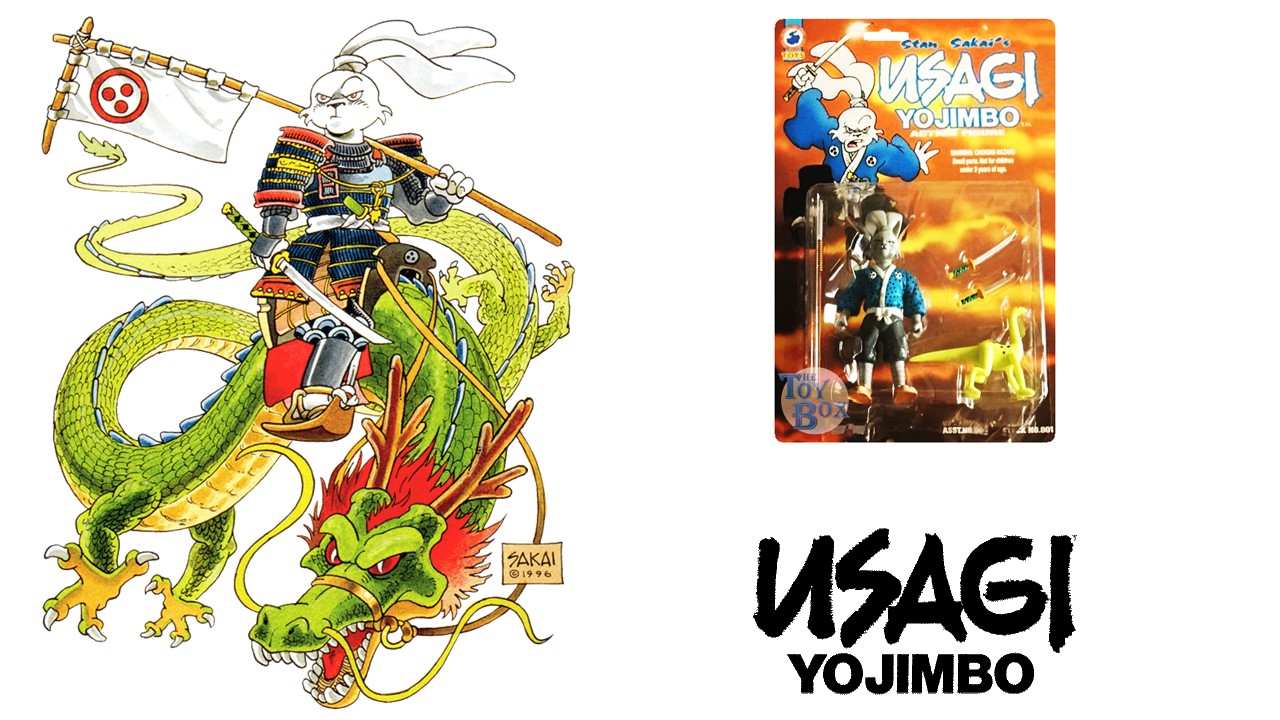
Usagi Yojimbo (Antarctic Press)


Usagi Yojimbo
Antarctic Press
1998

Many people know Usagi Yojimbo for his numerous appearances in Mirage's Teenage Mutant Ninja Turtles as well as the 80's TMNT cartoon - Which lead to the highly popular figure back in the day. However, Usagi is far more than just a here and there sidekick / ally to the Turtles. In fact, his real name isn't even Usagi Yojimbo. It's Myamoto Usagi.

Usagi began his comic book history in 1984 when creator Stan Sakai who conceived the character as a supporting role in The Adventures of Nilson Groundthumper and Hermy. However, as Sakai developed the character, he also created a world where he felt readers would be drawn into. Though he appeared in a few books here and there, it wouldn't be until 1987 that Usagi Yojimbo appeared in his own comic book title which is still being published today.

What has helped Usagi to become so popular is his inclusion in multiple crossover titles. This is made possible by Sakai who is the sole rights owner of the character. As such, he can determine when and where his character makes an appearance without having to first wade through the typical legal red tape which would accompany a corporate owned entity.

It's no doubt his appearance in Teenage Mutant Ninja Turtles made Usagi Yojimbo a household name among kids of the 80's, but it's only fair to say this is definitely not a one and done character. As we said above, he's by no means only a sidekick.

By 1998 Antarctic Press were struggling to find a foothold in the action figure market. They had released a few obscure lines since 1996, but had yet to produce that one item which would put them on the map. One of their last attempts was the very small, very short lived Usagi Yojimbo line.

The series is technically a one shot, with only Usagi being produced. However, it does contain some variants / exclusives. The mass market figure was produced on an orange card while the exclusives were produced on blue ones making them easily distinguishable.

If you're looking for a plastic version of Usagi Yojimbo which is spot on to his comic book iteration, then look no further. This figure captures all those details in magnificent detail with just the right amount of articulation. For added fun, the figure even comes packaged with a Tokage - Which for those of you who don't know, this is simply a dinosaur like creature which roams freely around the world of Usagi.

Fun fact: Tokage creatures have even appeared in Teenage Mutant Ninja Turtles.

Dark Horse Variant (Limited to 500)*Platinum Edition (Limited to 2,000)

Unfortunately for Antarctic Press, 1998 was the last year for them. It seems they were unable to really make make an impact in the world of action figures, and like so many before (and after) them found themselves going out of business.

What makes this all the more unfortunate is the fact that these days the Usagi Yojimbo figure is not only scarce, but also rather expensive on secondary markets. The variants will set you back anywhere from $40.00 to $60.00 a piece. The orange carded figure will set you back anywhere from $20.00 to $40.00. Not a bad profit for a line nobody wanted when it was originally released.

Click "HERE" to go back to the home page. For more posts related to this one, please click the labels below.

Teenage Mutant Ninja Turtles (Neca)


When Teenage Mutant Ninja Turtles launched in comic book form in May of 1984, the world could never have perceived the huge following such a small independent company (Mirage Studios) would build with only one title. Its initial 3,000 copies sold out almost overnight, and since then has seen numerous reprints of several issues of the 62 individual (comic) books.

Since its original conception, the series has been developed for television, film, a live rock and roll concert sponsored by Pizza Hut, and of course toys. Playmates produced the very first action figures based on the four brothers, which was in turn based on the concepts as seen in the animated series. We've touched on a few of those series in the past, but today we're focusing on the Neca series.


Right off the bat you can see the conceptual disgn difference between Playmates and NECA's toys. As we said, Playmates was based more on the animated show, while NECA's were based off the original designs for the comic book. This was both a pro and con for the series.

It was a pro because purist fans of the Turtles were able to get their hands on what they considered to be the "original" characters. For example, throughout the comic series, the four brothers all wore red bandanas. There was no distinguishing between the characters by colored ones as seen in the cartoon. This in turn led to one of the biggest cons of the series. People who weren't aware of this, specifically in foreign markets were confused by all of the characters wearing red bandanas, and didn't recognize the toys - Or rather, the individual characters.

Okay, these four "color" versions of the figures may be bootlegs, but in terms of quality, they're some of the best bootlegs ever produced. NECA never produced any of the Turtles with their colored bandanas. It's unknown who produced these, but they have duped many a fan and second hand dealer that they were getting a rare set of variants.


The toys contained an amazing amount of detail both to the figures and weapons/accessories. For the first series, NECA released all four Turtles both in a PVC bubble package, and in PVC tube packaging. Its uncertain why this drastic change was made between packaging midway through the series, but if we had to weigh in, we prefer the PVC bubble packaging to the tubes.

In addition to the individual packs, NECA released a four pack of the group. While the standard (full color) figures was more commonly found, it is rumored, but not confirmed that the black and white chase figure set (which was initially released at Comic Con - see below) was also made available via retail channels. The most notable difference would be that the retail version (again, if it exists) would not contain the San Diego Comic Con logo.

However, both sets were initially made available at specific conventions (again, see below).


Two PVC bubble packaged exclusive figures were produced for the line - Mouser (3 pack), and April O'Neil. Both were produced for San Diego Comic Con - The Mouser 3 pack for 2008, and April for 2009.

Much like the Turtles, the April O'Neil was confusing to collector's unfamiliar with the comic. In the initial story that April is introduced in, she wears a blue jump suit - Whereas in the cartoon series, the character was always seen in a yellow colored jumpsuit. For the purists, this was awesome - For the cartoon fans, again, confusing.

As we mentioned above, the four pack box sets were first made available at conventions. Both released in 2008, the full color turtles were sold at New York Comic Con, and the black and white set at San Diego Comic Con. The only difference in the packaging is the sticker adhered to the front.


This could also explain the supposed retail version of the black and white set. Since it is just a sticker, it is possible that someone removed it from the box, but we can't understand why someone would do that intentionally. So, until we know for sure, the supposed retail version remains a mystery.

What's interesting about the New York Comic Con full color set is that it is actually harder to find one that isn't autographed as opposed to ones that are. During the convention, Peter Larid, co-creator of TMNT was on hand to sign autographs. As a result, the majority of buyers of the four packs had them signed.

A second series was scheduled to be released, and even made it as far as the prototype phase. There are two major contributing factors as to why the series was never produced and released.

The first - Unfortunately the series was dealt a major blow when Playmates filed a claim against NECA that forbid them to sell the toys in retail stores due to their existing contract.

There were four figures set for release; Shredder, Foot Soldier, Shredder with Krang pack in, and April O'Neil. You'll notice that the prototype April O'Neil is actually the same as the San Diego Comic Con exclusive. However it was never intended for this particular version to be released.


The second - As we mentioned above, foreign markets in particular were confused by what they considered to be a new look for the characters, and as a result were not recognizing the figures for whom or what they were. To see if there was a strong foreign market for the toys, NECA planned to release figures one at a time to see if sales would justify production. The first attempt would have included April O'Neil as seen above. The regular figure would have depicted her in the yellow jumpsuit as seen in the cartoon, in hopes that she would be more recognizable to fans overseas. A chase variant with her in a green jumpsuit would also be produced and sold at the same time.

However, due to the first reason above, I.E. Playmates forbidding the toys to be sold in retail stores, this concept was never tested, and the series was put on hold with no official word of cancellation yet.

For us, this series is a thousand times better than Playmates original toys. We fell in love with the Turtles from issue one back in 1984, and love the idea of having toys based on it. Not that the Playmates toys were terrible, we love them too, but NECA's versions hold a much larger piece of our nostalgic loving heart. Plus, they’re just so cool looking.

We really hope that Playmates and NECA can come to some form of resolution that these second series toys (and beyond) can see the light of day. Though with the release of new figures from Playmates based on the new animated series on Nickelodeon, we don't know how likely this is going to be.

Join us next time when we take a look at Last Action Hero!

Click "HERE" to go back to the home page. For more posts related to this one, please click the labels below.

Teenage Mutant Ninja Turtles: 1990 and 1991 (Playmates Toys)


It's been over three years since we visited Playmate's Teenage Mutant Ninja Turtles in our original post. Years three and four (and beyond) have been a long time coming, and we're happy to revisit a toy line we have been so fond of over the past few decades. Let's jump right in!

By 1990 the Teenage Mutant Ninja Turtles were huge. They had a monthly comic book series, a daily cartoon, a movie (with a sequel in the works), toys (of course), a role playing game, and even a full blown concert tour - "Coming Out Of Their Shells," which was sponsored by Pizza Hut. Turtle Mania was a fast traveling train that surely wasn't going to derail any time soon.

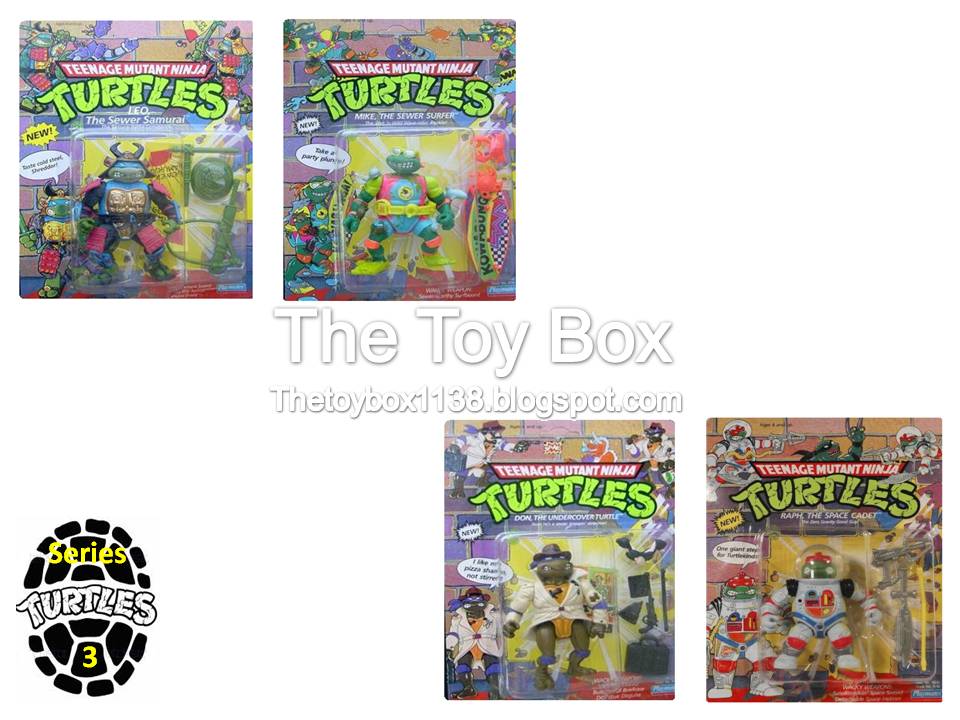
Playmates continued to support and produce the TMNT line with its latest toys and accessories. The third year, while not as strong as the prior years, was certainly larger. This time around, Playmates even produced variant figures. It would also mark the beginning of what would become an overabundance of variations to the turtle figures themselves (see year four for further information).


Leo the Sewer Samurai, Mike the Sewer Surfer, Don the Undercover Turtle, Raph the Space Cadet


The first variant figure was the new April figure which now sported a version that had a white "Press" badge on the front left side of her shirt. The figure was also produced without the badge.


April O'Neil (no press badge), April O'Neil (with press badge), Fugitoid, Mondo Gecko, Muckman and Joe Eyeball, Mutagen Man


The most notable and easy to spot variant figures are those of Ray Fillet. The figure comes with three different color variation vests.


Napolean Bonafrog, Panda Khan, Pizzaface, Ray Fillet (yellow vest), Ray Fillet (red vest), Ray Fillet (orange vest)


Scumbug, Slash, Triceraton, Wingnut and Screwloose


Two larger sized bugs were produced for the series that were also intended to be vehicles of sorts.


Killer Bee, Needlenose


The regular vehicles had a familiar feel to them, which carried over from the first and second series of figures (1988-1989). While they weren't necessarily things shown in the TV series, they definitely had a feel to them that was solid in the TMNT world.


Sewer Dragster, Turtlecopter, Sewer Party Tube, Sewer Seltzer Cannon, Sewer Army Tube


Psycho Cycle, Oozey, Mutant Module


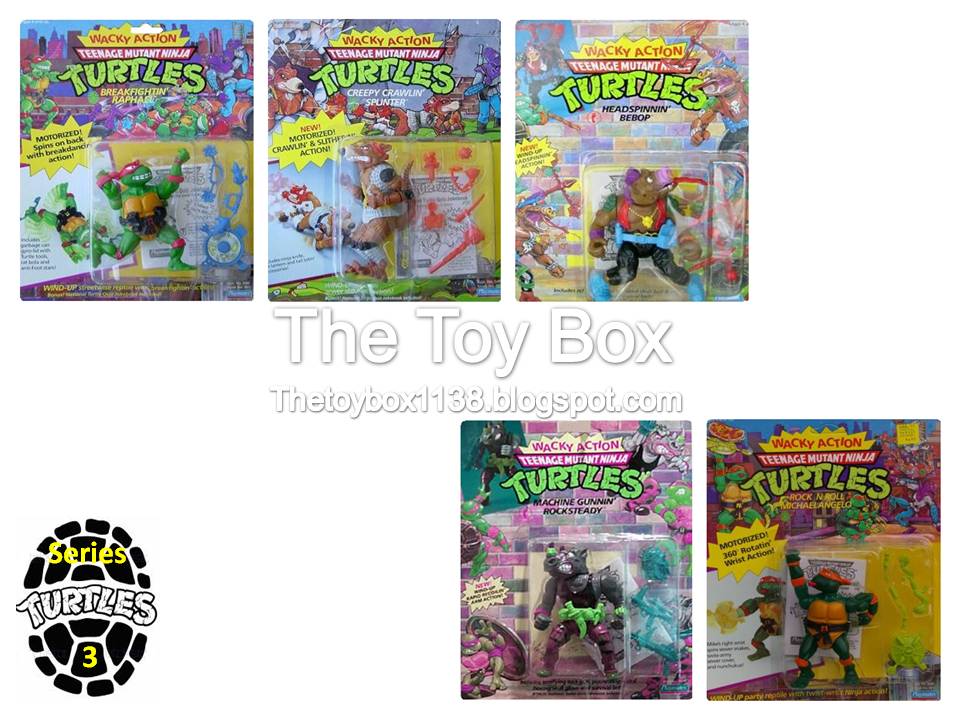
Playmates introduced a sub-line into the series known as Wacky Action. These figures were "motorized" by way of a wind-up mechanism on their backs. Each figure had its own unique "action" when engaged.


Breakfightin' Raphael, Creepy Crawlin' Splinter, Headspinnin' Beebop, Machine Gunnin' Rocksteady, Rock N' Rollin' Michaelangelo


Sewer Swimmin' Donatello, Slice N' Dice Shredder, Sword Slicin' Leonardo, Wacky Walkin' Mouser


Though part of the Wacky Action line, these related vehicles kept their look and feel of the regular vehicles line.


Sludgemobile, Toilet Taxi


Series four (1991) became the beginning of the end for a lot of Turtle fans, but at the same time continued to rake in enough money that the series continued for several more years. The biggest problem with the toy line would quickly become an overabundance of figures based on the Turtles.

Worse was that the variations seemed to be no more than an excuse to produce figures. From athletes to soldiers to punkers and beyond, Playmates seemed determined to dress the Turtles in any fashion of clothing they could come up with. It was overkill at its best, and the beginning of an oversaturated market of Turtle toys.


Chrome Dome, Dirtbag, Groundchuck, Hose 'Em Down Don, Make My Day Leo, Sergeant Bannans


Space Usagi, Tatoo, Walkabout, Skateboardin' Mike, Wyrm, Zak the Neutrino


With Teenage Mutant Ninja Turtles II: The Secret of the Ooze in theaters, it was inevitable that figures would be produced - Though surprisingly, not many.

Tokka was produced with both an orange and green shell, though since you cannot see this variation by looking at the front of the package, we have only included a photo of the green shell version.


Rahzar, Super Shredder, Tokka


The first new sub series produced in 1991 was the Headdroppin’ line. The figures were designed to do exactly as they sound like they did, I.E. drop their heads into their shells.


Headdroppin' Leo, Headdroppin' Mike, Headdroppin' Don, Headdroppin' Raph


Mutant Military figures was the second sub-series of 1991. This depicted the Turtles as a particular branch of the military.


Lieutenant Leonardo, Midshipman Mike, Pro Pilot Don, Raph the Green Teen Beret


Rock'n Rollin' Turtles was the third sub-series of 1991. These figures depicted the Turtles in music genre appropriate garb.


Classic Rocker Leo, Heavy Metal Raph, Punker Don, Rappin' Mike


Sewer Sports All-Star Turtles was the fourth sub-series of 1991. These figures depicted the Turtles in various sports related gear.

While some collector's consider the prior mentioned Skateboardin' Mike to be a part of this line, you can see from the design of the two cards that it really isn't.

The line consisted of two sets, three with red boarders, and three with yellow for a total of six figures.


Shell Slammin' Mike, Grand Slammin' Raph, Shell Kickin' Raph, Slap Shot Leo, TD Tossin' Leo, Slam Dunkin' Don


Storage Shell Turtles was the fifth sub-series of 1991. It consisted of the four basic Turtle figures with a unique twist. Their shells could be open to reveal a storage area for their accessories which came packed in with each figure.


Storage Shell Leonard, Storage Shell Michaelangelo, Storage Shell Dontalleo, Storage Shell Raphael


Talking toys were a major attraction for children of the early 90's. Thus, the sixth sub-series of 1991, Talkin' Turtles were a huge success.


Talkin' Leonardo, Talkin' Michaelangelo, Talkin' Dontaello, Talkin' Raphael


If one thing was consistent with the Turtles toys, it was the vehicles. Much like the prior year, it stayed on par with the overall look and feel that fans had come to expect from the series.

In fact, two of the vehicles were so similar, that they just threw the Roman numeral II at the end of the name.


Turtle Blimp II, Cheapskate II, Leo's Turtle Trike, Raph's Turtle Dragster, Rocksteady's Pogocopter


Halfway through the release of vehicles, the boxes were redesigned (of sorts) to now show a much nicer image. Rather than depict a cartoony look, they now had a fantastic painted look to them.


Don's Kookie Carnival Card, Leo's Jolly Turtle Tugboat, Ninja Newscycle, Shreddermobile, Shell Top 4X4


Sewer Sub, Turtle Tank


It's important to note a couple aspects of the vehicles for 1991. For starters, the Sewer Sub and Turtle Tank have box variations. The ones not shown contain the same artwork, but a blue stripe with white stars around the edges.

Second, while the majority of the vehicles don't say so, there are some that are put of the various sub-series of figures. These are as follows;

Don's Kookie Carnival Car (Wacky Action)
Leo's Jolly Turtle Tugboat (Wacky Action)
Rocksteady's Pogocopter (Mutant Military)
Sewer Sub (Mutant Military)
Turtle Tank (Mutant Military)

Beyond that, the rest of the vehicles are considered to be part of the main toy line.

The Turtle line was definitely growing. The toys for 1990 and 1991 far outweighed the amount produced in the first two years, and each subsequent line would seem to only get bigger and bigger. We'll definitely be back to visit the Turtles again in the near future, but until then, thanks for reading.

Join us next time when we take a look at Batman: Mask of the Phantasm!

Click "HERE" to go back to the home page. For more posts related to this one, please click the labels below.

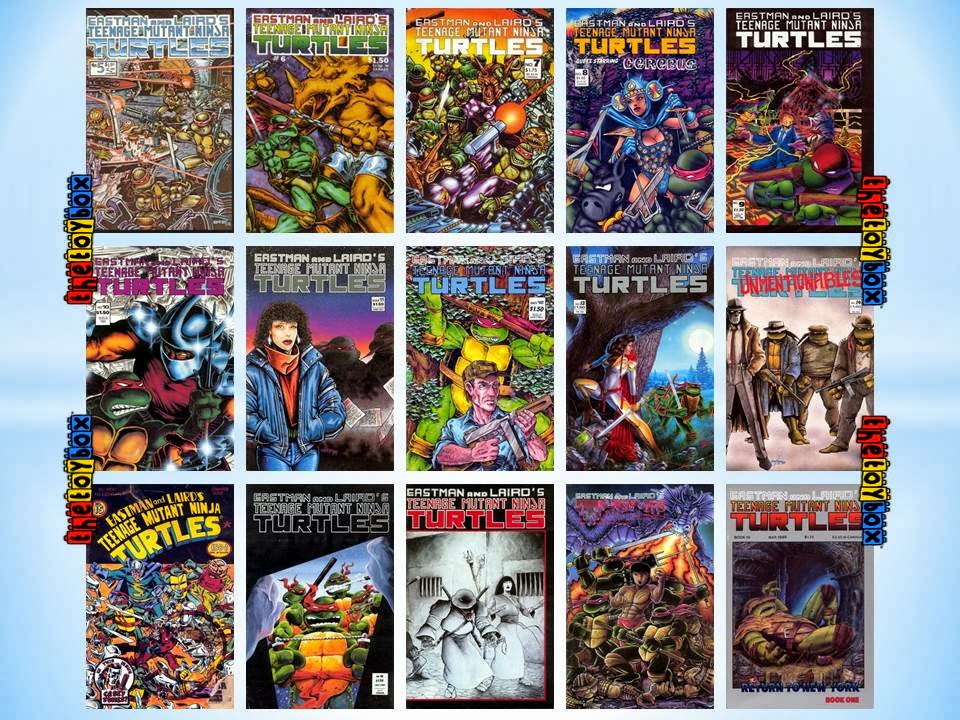
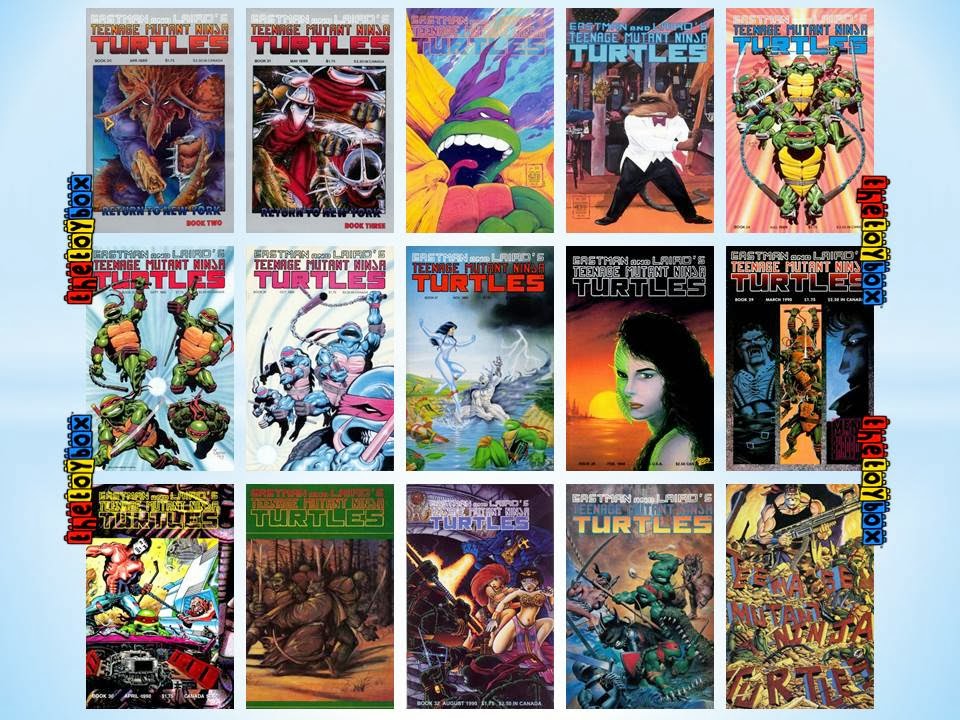
Teenage Mutant Ninja Turtles Comics (Mirage)


In the years since the Teenage Mutant Ninja Turtles were created, Michelangelo, Leonardo, Raphael and Donatello have become a classically comical part of Americana.

Kevin Eastman and Peter Laird, the creators of the Turtles, published their first black and white TMNT comic book with just $1,200 in 1984. With tons of work and a plethora of good fortunes, they've seen the Turtles go from an underground hit to a world-wide phenomenon. It's been a wild and crazy ride, to say the least!

After a long day of work way back in 1983, Kevin and Peter were relaxing at Laird's house watching television and sketching. "We got real punchy!" Peter explains, and they started drawing cartoons to amuse themselves. At the time Peter was doing editorial illustration and advertising art with some success while Kevin was working as a short-order cook and drawing comics in his spare time. As the evening evolved, Kevin eventually drew a bipedal turtle with Nunchukus strapped to its arms and called it a "Ninja Turtle". Peter, aware of a nifty idea when he saw one, asked "Why not a teenage mutant ninja turtle?" and thus the legend was born.


Eastman and Laird liked the Teenage Mutant Ninja Turtle idea too much to let it remain idle in their sketchbooks. The creative duo wrote an origin story that parodied Frank Miller's Daredevil and Ronin series, comics that Kevin and Peter held in high esteem. The lone Teenage Mutant Ninja Turtle became a group of four terrapins who had a ninjitsu sensei, a mutated rat named Splinter. Kevin and Peter experimented with drastically different costumes for each Turtle, but the artists finally settled on a singular outfit that the mutant quartet would share. Each Ninja Turtle was named after a renown Renaissance artist.

"We had all the Japanese fighting methods, but we didn't want to make up Japanese names because we thought they'd seem too strange to American readers." explains Kevin. "So we decided to go in the opposite direction and used distinctly European names. We both had studied art history, so we picked Raphael, Donatello, Leonardo and Michelangelo."


Back in those days, neither Kevin nor Peter owned a computer with a spell-checker, so Michelangelo was misspelled as "Michaelangelo". Fortunately, everyone seemed to get the point, regardless of the additional letter "a". Once Mirage was able relaunch the Turtles franchise in 2003, Peter decided to right the old wrong, and Mikey now spells his name correctly as Michelangelo. It's never too late to fix a mistake. :)

With the story written, Kevin and Peter began doing the artwork. Since the creative duo had similar styles, they were able to switch tasks back and forth. Some pages were penciled by Kevin and inked by Peter, some pages were penciled by Peter and inked by Kevin. Once the complete comic book was finished, they set out to find a publisher for it. Much to their dismay, the guys had no luck finding someone willing to print the title.


Kevin had just gotten a $500 income tax refund check, so the artists decided to self-publish the comic book. They borrowed an additional $700 from Kevin's uncle, Quentin Eastman, and used the money to print 3,000 black and white copies of the first issue of the TMNT. The artistic duo still had enough money left over from the costs of printing to take out a single one-page advertisement in a popular comic book newspaper entitled Comics Buyer's Guide.

"We expected to sell them all as single copies through CBG." Peter remembers. "Instead, we got calls from distributors and learned about the wonderful world of discounts."


Distributors buy wholesale copies of a publisher's books, typically at a 60% discount, and then sell the comics directly to the retailers at discounts ranging between 40-58% off of cover price, depending on volume. With the new information in hand, the TMNT comic was made available to the comic book distributors, which in turn made it easier for the comic shops to order the book. Retail distribution also relieved Kevin and Peter from the arduous task of individually packing and shipping their comic!

The first issue of the TMNT went to the printer on April 1, 1984... no foolin'! The printer finished the job in time for Peter and Kevin to debut the title at a comic book convention in Portsmouth, New Hampshire on May 5. Oddly enough, the printer hadn't printed the Turtle comic in the usual comic book format. TMNT #1 was an over-sized book.


"We'd gone to a printer (who knew nothing about printing comics) with a locally produced TV schedule giveaway." Kevin commented. "We told him, 'This is what we want: a colored stock cover and black and white newspaper inside.' We never thought to specify size, so he printed the issue in the same dimensions as the TV schedule giveaway we used as a sample!"

Kevin and Peter decided to name their new publishing company Mirage Studios; since there wasn't an actual studio (only kitchen tables and couches with lap boards), they thought that "Mirage" was a fitting moniker. Peter had experience working with newspapers, so the pair made up a four page press kit with a story outline and artwork that they sent to 180 TV and radio stations. On a whim, they sent the package to the Associated Press as well as United Press International. This initiative proved highly valuable, as several local newspapers ran long stories on Mirage Studios and their creation, the TMNT. PBS radio also did a five minute story on the mutant terrapins, and perhaps most significantly, a reporter from the UPI wrote a story about the Turtles that was picked up on the national wire and ran in countless newspapers across the USA. This massive exposure created a demand for the interestingly titled comic that caught everyone by surprise! All 3,000 issues sold out quickly, much to Kevin and Peter's delight! A second printing of the comic book went to the printers and sold out its print run of 15,000 copies, and was followed shortly by a third printing that sold out its run of 35,000 issues! The Teenage Mutant Ninja Turtles hit the starting gate at full speed!

The success of the TMNT comic book led to other projects. Palladium Books produced a pen and paper role playing game featuring the Turtles, Dark Horse Miniatures produced several sets of TMNT lead figures for the RPG (and collectors alike) and First Comics produced full color reprint volumes of the original series. Kevin and Peter continued to produce Turtles comics as quickly as they could and their popularity grew.

"When we created the Turtles, we wanted to spoof the world of super hero characters and poke good natured fun at the heroic but not-so-funny characters that dominated the business." said Peter. "The Turtles are fun heroes with an attitude. Basically, they act and think like average teenagers."

"They're always willing to lend a helping hand, but are constantly on the alert for the funny side of life." added Kevin.

It's a formula that has worked well!

As the popularity of the comic grew, attention outside of the comics industry flourished. As stated above, the first issue of the TMNT had an original printing of only 3,000 copies, but by the time Turtles' licensing agent Mark Freedman came aboard, the comic was selling over 125,000 copies (making it perhaps the most successful self-published B&W comic in the USA.) Mark caught wind of the Turtles thanks to Palladium's TMNT RPG book and was excited by the look and attitude of the characters. Believing that he could expand upon the Turtles' success, Mark contacted Peter and Kevin.


Through much trial and tribulation, Mark connected the TMNT with a small toy company interested in breaking into the boys action figure market and willing to take a chance on a concept that all the major toy companies thought was too risky (be wary of the opinion of "experts"). Playmates Toys agreed to produce the action figures if a television deal could be struck, and Mark pulled it all together upon meeting with animation producers Murakami, Wolf, Swenson, Inc. A five episode mini-series was produced for syndicated release, and within days of the show airing, it was apparent that the TMNT would prove to be every bit as popular to the television audience as it already was with comic readers. From there, Mark's company, Surge Licensing, formed an unstoppable marketing powerhouse that set a new standard of excellence in the licensing and merchandising industries!


Click "HERE" to go back to the home page. For more posts related to this one, please click the labels below.