Showing posts with label 2000's. Show all posts

G.I. Joe Survival Beverage (Desert Holdings, Inc. In Conjunction With Hasbro)


G.I. Joe Survival Beverage
Desert Holdings, Inc. in conjunction with Hasbro
2000

While visiting a local estate sale, I came across these really odd bottles of G.I. Joe Survival Beverage. The prior owner appeared to have three different kinds, but I soon learned there was a fourth in the "series". Not wanting to leave these unique licensed items behind, I picked up the three available. Ebay would later help me finish the set.

Gung Ho Grape was the first of the three I noticed, and I was happy with the thought of G.I. Joe related drinks associated with character names. My head flooded with a quick image of some of the possibilities, but this was quickly dashed to bits when it dawned on my that the use of the name was merely coincidental. In fact, the names were simply just a play on common military terms, Commando Cherry, Gung Ho Grape, Infantry Orange, and Platoon Punch. Oh, the possibilities that could have been. Such a wasted opportunity.

Commando Cherry

I've never personally tried any of these drinks before, and considering they were produced in 2000, I will not be. However, from what I have been gathering from other various bloggers who have memories of these, they allegedly were not very good, thus contributing to the quick reduction of price, and discontinuation. The bottles I picked up were blown out at retail at fifty cents for two. Clearly, these were drinks retailers were eager to get off their shelves.

Gung Ho Grape

Each flavor comes in a plastic canteen, boasting three servings per container with a whopping 22 grams of sugar per serving. To put that into perspective, the average recommended serving of sugar per day is between 24 and 36 grams, depending on if you are male (higher end) or female (lower end). Looking at the ingredients, this is 100% bad for you in every sense of the word. For fruit flavored drinks, there doesn't appear to be any actual fruit within. Filtered water, and high fructose corn syrup are the top two ingredients. Which is odd, because the drinks also boast a small percentage of vitamins and nutrients. How?

Infantry Orange

Despite my attempts, I could not find any information for the company behind the product, Desert Holdings, Inc. out of Scottsdale, Arizona. It's possible that when the product failed on the market that the company itself didn't survive either.

Platoon Punch

What makes my particular set of these canteens appealing to me is that they are one hundred percent sealed with the "juices" still inside. Mind you, while I have zero interest in cracking these open, knowing that the strange concocted brew is still bound within is rather desirable to me. While sealed ones are certainly not as common as empty bottles, they're still relatively easy to find. It seems like for every one bought two pop up.

The average price for sealed bottles is anywhere from six to eight dollars a piece, which isn't bad when you think about how much some of these fly by night discontinued drinks from yesteryear can go for. Empty bottles go for two to four bucks, and are a bit more common than their brand new counterparts.

This is definitely a unique collectible I would recommend for G.I. Joe collectors. It's not one that too many people seem to have, or really know about.

Click "HERE" to go back to the home page. For more posts related to this one, please click the labels below.

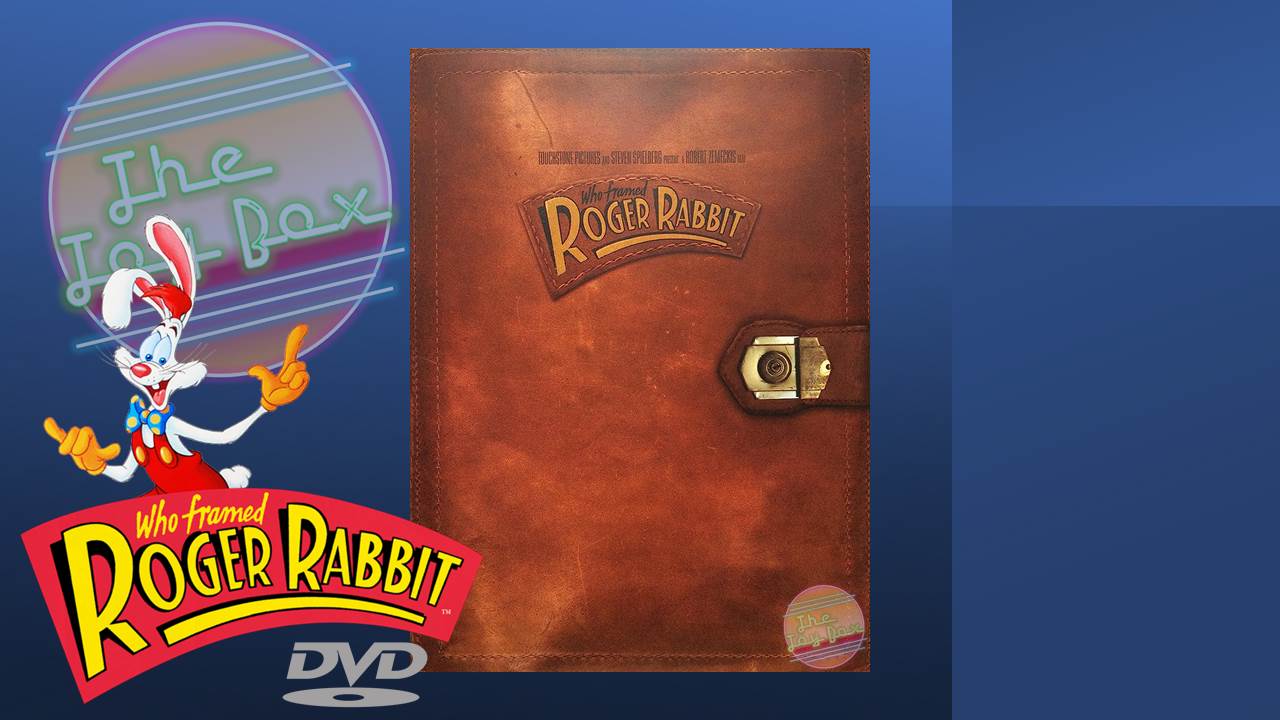
Who Framed Roger Rabbit Vista Series DVD


Who Framed Roger Rabbit DVD
Vista Series
2003

I wouldn't normally pull a random DVD out of my collection and focus a post on it, but today's entry is no generic set of discs. No, today is what I would consider to be the most superior release of Who Framed Roger Rabbit to date.

The film debuted in theaters on June 22, 1988, and would be heralded as one of the greatest collaborations of multiple studios of all time. Though the primary focus was on the newly created protagonist, Roger Rabbit, movie goers were treated to iconic characters from multiple generations. So many were present, it would encompass a post unto itself to list them all.

On October 12, 1989, fans would finally get a chance to own the film on VHS. Almost a full decade later, July 8, 1998, it would make its way to laserdisc. It was around this time that the infamous rumors started spreading about a particular scene which could be perfectly paused to see particular aspects of Jessica Rabbit. As such, the laserdisc copy quickly became popular with film buffs who could afford the media format. The following year, on September 28, 1999, Who Framed Roger Rabbit was released on DVD. However, at this point in time, the media was still relatively new, and not too common in households.

On March 25, 2003, Vista Series packaged the film into a very special release. This is the particular version which piqued my attention, and the one I want to showcase today.


From the exterior of the package, you can visually see already that you're in for something special. The slipcase features a gorgeous metallic finish on the front, and the back hearkens back to the design reminiscent of Disney Animated Classics layouts. In particular, I pick up on a Many Adventures of Winnie the Pooh vibe, but that may just be me.


No details were spared in creating an eye catching cover that would easily grab your attention from across your local retail store.


Removing the cover, or slipcase, as it were, reveals the next layer of goodness within. A magnificent gate-fold faux leather book, albeit, made of cardboard, displays the name of the film. It's classy in its own right. Subtle, but highly affective.


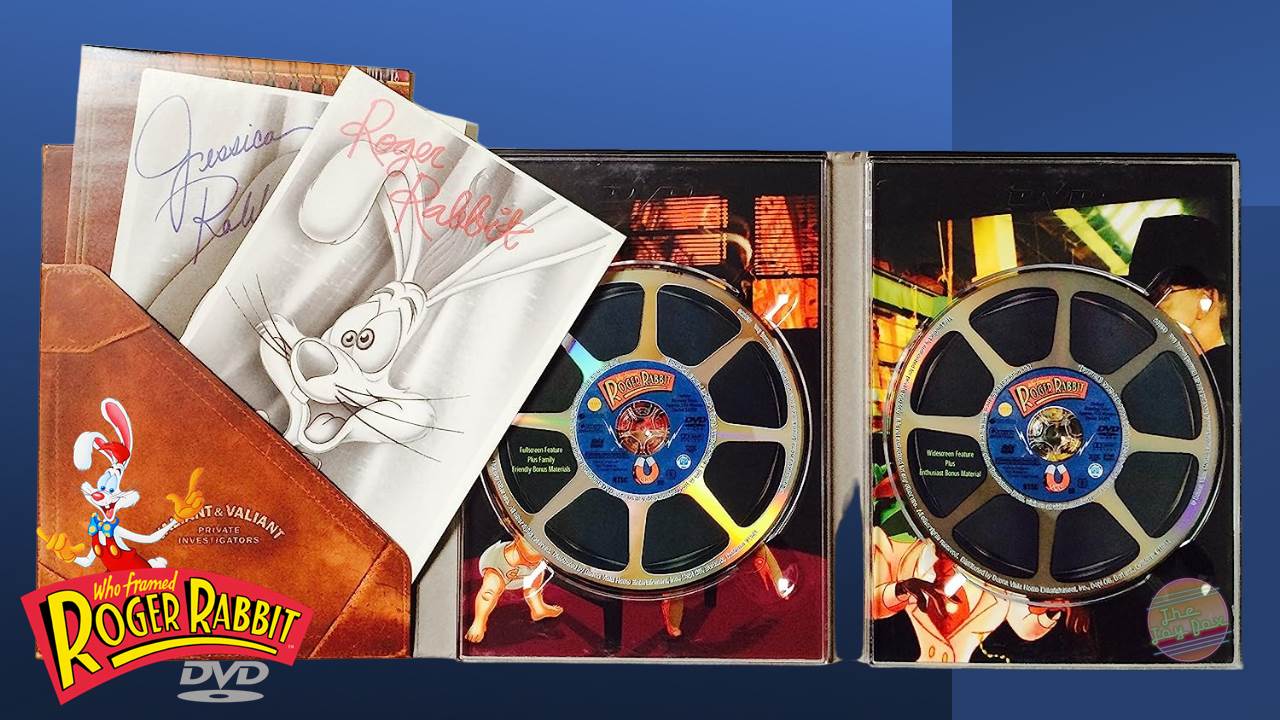
Folding it open, your eyes are met by a pocket stuffed with inserts, and a makeshift image as if you were looking down at the desk of Eddie Valiant, carefully reviewing a photograph through a magnifying glass, with the newspaper slightly beneath it. To the right of it sits evidence in the form of R. K. Maroon's hand buzzer, and above an additional two photographs.


Folding it open again is where you'll be met by two beautifully designed DVD's, made to look like classic movie reals. The Valiant and Valiant Private Investigators logo shines on the exterior of the makeshift pouch next to them, beckoning you to rummage through the goodies within. But, not yet.


Removing the discs reveals yet another layer of visuals hidden beneath. The visuals just keep popping, stunning your eyes with magnificence. It makes you want to poor over every detail, to find and see everything.


Disc number one, labeled as "family friendly", features the film in its THX Certified fullscreen format, and also includes all three of the Roger Rabbit Shorts; Tummy Trouble (shown before the 1989 theatrical release of Honey, I Shrunk the Kids), Rollercoaster Rabbit (shown before the 1990 theatrical release of Dick Tracy), and Trail Mix-Up (shown before the 1993 theatrical release of A Far Off Place).

Disc two, labeled as for the "Enthusiast", presents the film in its THX Certified widescreen format, and comes chalk full of bonus features such as commentaries, deleted scenes, behind the scenes, galleries, trivia, and more!

The movie reel designs really pop on the discs, and make them feel all the more nostalgic to me. In fact, it's what initially drew me to this particular version.


Not forgetting about the pouch full of goodness, that includes two glossy pictures "signed" by their respective characters, Roger and Jessica Rabbit.


Lastly, there is a makeshift Valiant and Valiant Private Investigators notepad, which when flipped open goes into detail of the contents on both discs.


If that wasn't enough for you on its own, stores such as Sam's, BJ's, and Costco received longbox versions which housed the entire package above in an upscale package design created specifically for the release.


Even though VHS was in decline in 2003, Vista Series even released the film in that format, though it's far from as exciting as the DVD set. Aesthetically, it's mediocre at best.

Since then, the film has continued to be released on DVD, and made its way to Blu-Ray on March 12, 2013. It has even been released on 4K Ultra HD Blu-Ray as of December 7, 2021. However, the bang for my buck, and this thing will set you back no more than five bucks these days, is the 2003 Vista Series release. Just by looking at it, you can see that this was not just an average release. This was made with love, care, and respect for the film and fans.

Click "HERE" to go back to the home page. For more posts related to this one, please click the labels below.


Rubik's Cube (Ideal)


I had one. You had one. We all had one. As children of the 80's it was impossible not to own a Rubik's Cube at some point. It was every parent's favorite educational game / toy, and a blessing on car rides in a pre handheld gaming world.

Magic Cube, or Bűvös kocka, as its original 1975 patent translates it in Hungarian, was created by Ernő Rubik, as a tool for solving the structural problem of moving the parts independently without the entire mechanism falling apart. Rubik stumbled upon the concept that he had created a puzzle box when shuffling the squares for the first time, and attempting to restore it.

The first cubes were sold in Budapest toy shops in 1977. However, it wouldn't be until Rubik met Austrian salesman, Tibor Laczi, that the small puzzle would garner its greatest success. With the approval of the inventor, Laczi took the Cube to Germany's Nuremberg Toy Fair in February 1979. It was here that it garnered the attention of Seven Towns founder Tom Kremer, who worked a deal with Ideal Toys to release Magic Cube worldwide.

Ideal wanted a name that was recognizable, and could be trademarked. It was this thought process that lead to the box being named after its inventor, and the name was officially changed in 1980. However, this wasn't until after the toy manufacturer considered other names, such as The Gordian Knot and Inca Gold.

In addition to the name change, Rubik's Cube underwent significant revisions to meet with safety regulations in the West. Part of these changes incorporated an overall lighter puzzle box. With everything in place, production began, and the first wave shipped from Hungry in May of 1980.

Though sales were mild at first, Ideal set in motion a heavy advertising campaign which pushed the toy into the spotlight across homes via daily newspapers. As sales picked up, so too did its notoriety, winning the puzzle several awards across Germany, UK, USA, and France.

By 1981, Rubik's Cube was a household name, with sales estimated at two hundred million worldwide. This year also saw the first speed championship hosted by the Guinness Book of World Records. For those who remained in the amature class, several published books regarding solving the Cube were also released to help with the puzzle.

Popularity of the toy even caught the attention of ABC Television, who secured the rights, and developed a cartoon as part of The Pac-Man / Rubik, the Amazing Cube Hour block. The series ran for one season, consisting of thirteen episodes which aired from September through December of 1983.

Sales dropped in 1982, with the New York Times reporting that the craze had died. However, this was only true in the USA. Whereas in several communist countries, demand remained high, with the toy continuing to be sought after from initial shortages. Though it is fair to say that overall sales had definitely plummeted by 1983 as compared to 1981.

Despite this, the Rubik's Cube has remained a staple item on toy shelves for decades, even seeing a revitalization in the 2000's. Championships also resumed for the first time since 1982 in 2003, and have remained a mainstay across the globe as people continue to battle for the coveted Guinness World Records title for fastest time. Feliks Zemdegs is the current title holder, solving the cube in 4.22 seconds.

As for me, I'll have to suffice for the tried and true tactic of peeling the stickers off, and unscrewing the center bit which holds it in place. I doubt I'll be winning any records going that route, but hey, I too solved the mystery of the Rubik's Cube.

Click "HERE" to go back to the home page. For more posts related to this one, please click the labels below.

The Simpsons: A Retrospect And Home Video Release


INTROUDCTION

For a lot of us, The Simpsons have long since run their course. Personally, I don't even know anyone who watches the series these days, myself included. However, we'd be lying if we said there wasn't a time where many of us were dedicated fans, tuning in every night the series aired.

CRITICAL AND FAN RECEPTION

When it first began in 1989, the animated series was different. Not only was it a refreshing take on prime time cartoons, but to sitcoms in general. Where other shows of its time stuck to the tried and true formula of the perfect family who all got along, and could resolve all of life's problems in twenty-two minutes, The Simpsons depicted the realities of life. Where families had flaws, fought amongst each other, scrapped by financially, and rarely, if ever,  got ahead. Not only was it entertaining, but also relatable to your average viewer.


Homer, Marge, Bart, Lisa and Maggie delivered an animated take on real life, sprinkled with comedy, and a multitude of characters that would become household names across the globe. The world of Springfield was vast, and fleshed out, with even the most minor of characters ultimately getting a back story over the seires ongoing, and seemingly never ending run of thirty plus seasons.

The series spent its first two seasons feeling its way out, and carving its own identity. It's because of this that while there are good episodes to be found in these earlier seasons, they're not considered to be part of the prime period of the series. This honor usually goes to seasons three through eight, potentially, ten, depending on who you ask.

In the height of its popularity, The Simpsons averaged between fifteen and twenty-five million viewers (seasons one through nine), rapidly declining to eight million viewers between seasons ten and eleven. What's interesting about this dip in viewers is that it coincides with a timeline many fans these days say the series jumped the shark.


SERIES DECLINE

Episode two of season nine, The Principal and the Pauper, took everything viewers knew and loved about Principal Seymour Skinner, and threw it all out the window. While at the time it was highly rated, it has since been panned by critics and fans who pinpoint it as the starting decline of the series. Even actor Harry Shearer came forward in a 2006 interview to give his own opinion, stating he told the writers it was a bad idea, and disrespectful to the audience.

Writers moving on from the series also contributed heavily to its overall feeling of decline. Homerun hitters like John Swatrzwelder, Jon Vitti, Al Jean, Michael Price, and Conan O'Brien, just to name a few, left to pursue other opportunities, leaving new writers, many of which seemed unfamiliar with the characters, to pick up the mantle. While this isn't uncommon for a long running series, it can be problematic.

Jokes which before felt thought out, and tweaked to perfection, became fewer and further between. This often resulted in quick gags or one-liners which fell flat. Additionally, the show was heavily saturated with guest star appearances, often resulting in derailed and paper thin plots devised to shoehorn in actors and actresses, rather than deliver solid storytelling.


Viewership rose slightly with season twelve, but since then, ratings have been in steady decline. The average viewers as of 2022 were down to two million, a massive drop from the show's prime. Yet, despite this, no ends is seemingly in mind for the show which has recently been renewed through 2023.

FURTHER DECLINE

The Simpsons has always had a mainstay of diverse characters, and it could probably be said that this was something which helped it to be so multicultural. The voice actors and actresses made it a point to provide life to a range of ethnicities and races. However, in the me too movement which has taken over our world, this became problematic in 2021.

Suddenly, the actors behind the voices of  Apu, Carl, and Dr. Hibbert was taboo. Racist, if you will. Under the regime of Disney, this simply wouldn't do, and this prompted immediate change to casting. A missed opportunity if you ask me.

Rather than find a clever way to retire these personalities, and create new ones which could have introduced contemporary and diverse characters, the show simply changed the actors voicing them. This caused the fans to be split, and that is never a good thing.


Fox missed the opportunity to breath new life into the show, which in turn could have brought in a new audience. The show could have even potentially been redeveloped into The World Of Springfield, where The Simpsons themselves are no longer the show runners, and this new iteration goes on for the next thirty years under the guise of new lead characters.

PERSONAL REFLECTION

Being a young kid when it first aired, I was definitely a fan of Bart. His mischievous mindset was relatable, and his hijinks amusing. However, as I grew older, things shifted. I soon found myself favoring Homer, and actually despising Bart, who I felt needed a good spanking. It appeared that even the series runners were more so partial to The Simpsons head of household, as episodes seemed to shift focus from Bart and his antics to Homer and his struggles.

However, along the way, I also found myself invested in several other characters. Like I said above, this was helped by the overall fleshing out of the series, where even the seemingly most unimportant character suddenly got an impressive backstory.


Was it a perfect show? No, not by any means. I always felt episodes were hit or miss, even during its prime. But, it did eventually reach a point where it wasn't entertaining at all.

In writing the above sections on the show's decline and further decline, it really dawned on my where The Simpsons derailed for me. Flat jokes and guest stars aside, The Simpsons never evolved. The age of the characters today, are the same as they were when the series first launched. Nobody has moved forward. The characters have changed, but only as a product of our time, not because the characters themselves have grown in wisdom or epiphany with age.

I suppose to some, there is a comfort in that regard. Where we as people move ever forward in time, The Simpsons are locked in an era of time that stands still. I can definitely understand the appeal in that regard, and respect it, as I feel it's no different than how I collect 80's toys and music to stay forever grounded in that decade.

HOME VIDEO RELEASE

While it was no stranger to VHS home video releases during its run, leading up to the debut of season thirteen in 2001, Fox Home Entertainment began releasing the series on DVD. Up until this time, the format stayed more so geared towards movie releases, and as a result, television shows, which often needed multiple discs to capture an entire season or series, were expensive. A single season could easily cost between fifty and one hundred dollars, making them desirable to many, but too costly for some.


Fox released the first twenty seasons on DVD, as well as the movie, which falls between season eighteen and nineteen, and as time passed, these prices began to drop as DVD sales rose, making them a cheaper and more feasible format to produce. The average season fell between a more reasonable twenty and thirty dollars.

However, in 2020, Fox announced that they would cease home video releases due to sales dropping in lieu of digital downloads and streaming. While this isn't surprising, it's definitely disappointing to physical media collectors. Especially since streaming services have been known to edit content to appease the overly sensitive nature of people these days. Meaning, it's possible that the episodes in their original format could be edited out of existence if not obtained physically.

It's not impossible to think that The Simpsons would receive an ultimate home video release upon the series ending. That is of course if physical media even exists at that point. With no ending seemingly in sight, who knows if DVD's will even exist at that point.


CLOSING

There is true wisdom in Jerry Seinfeld's decision to bow out while at the height of his popularity, and at the top of the ratings. Seinfeld is remembered fondly as a classic television series. Meanwhile, The Simpsons, when it does finally end, will go out with most people saying, "It's about time." The show has long since missed its opportunity to bow out gracefully, and go out with any form of dignity and grace.

Click "HERE" to go back to the home page. For more posts related to this one, please click the labels below.

Rambo: The Force Of Freedom (Ruby-Spears Enterprises)


Rambo: The Force Of Freedom
Ruby-Spears Enterprises
1986

Rambo: The Force Of Freedom gets the honor of being the very first animated cartoon series for children based on a movie rated R. It was controversial at the time, and as I think about it, would probably be controversial if released today. Imagine a kids cartoon based on Squid Games. Wow, that would actually be pretty cool.

The series involved lead character, Rambo, as the head of The Force Of Freedom taking the fight to terrorist group, S.A.V.A.G.E., headed by General Warhawk. Rambo's team ultimately took their orders from Colonel Trautman, but in terms of the overall characters the teams were vastly uneven. While there were seven good guys which encompassed The Force Of Freedom, there were a whopping twenty-three bad guys who made an appearance in the show.
As was the case, a toy line was released to heavily promote and coexist in conjunction with the show. I covered that quite some time ago, "HERE".

The cartoon itself ran for sixty-five episodes over the course of one season in 1986. There would eventually be a DVD release over six volumes between June and December 2005 by Lionsgate Home Entertainment, who also own the rights to the Rambo films.

This is where today's post lands, taking a look at the individual volumes.

Volume 1: A World Of Trouble

Volume 2: Enter The Dragon

Volume 3: S.A.V.A.G.E. Island

Each volume contains one disc, which (for the most part) features eleven episodes. The only exception is volume three, which contains ten. As a whole, this set encompasses all sixty-five episodes of the complete series.

Volume 4: Up In Arms

Volume 5: Snow Riad

Volume 6: Face Of Freedom

The DVD's have long since gone out of print, and remain relatively scarce on secondary markets. It's because of this that individual volumes can sell for as much as thirty to sixty-five dollars used. This is also the driving factor as to why the set remained on my want list for quite some time.

I was shocked when I recently found a complete set of all six discs for a buy it now price of $100.00, and five of the discs were brand new / unopened. I was not about to pass this opportunity up, despite the seller wanting an additional $25.00 for shipping. It was well worth the price in my book.

The opportunity was so great that I waited skeptically for them to arrive, wondering if the seller would relist them for a higher price, and then torture me for a long and drawn out refund process. Fortunately, this never happened.

With that said, I need to excuse myself. It's time to start watching some Rambo!

Click "HERE" to go back to the home page. For more posts related to this one, please click the labels below.