Showing posts with label 1930's. Show all posts

Walt Disney's Donald Duck And Mickey Mouse Club Projector (Stephens Products Co.)


Walt Disney's Donald Duck and Mickey Mouse Club Projector
Stephens Products Co.
1946

We're heading way back this time. All the way back to the forties to an era before home videos. A day and age where if you wanted to see a movie at home, it would have been on a projector, typically owned by the rich and famous, or in a kids toy version. That's where we meet up with the really cool Donald Duck and Mickey Mouse Club Projector from Stephens Products Co. These things are designed for fans young and old, making it a fun toy for kids of all ages. I'm not lying. That's what is says on the box.


Opening up the package, you're greeted by a folding open show curtain, which reveals the projector inside. It's here you'll also see the words, "Auto-Magic Theater. It was in digging in further to these words that I found further information, pinpointing the year 1946, as printed on the side of the film reel box. I also learned that Stephens Products Co. initially released what they called the Auto-Magic Picture Gun, a pistol shaped image projector.


I was able to find two different Disney themed versions of the toy gun, one branded as Disneyland, and the other based on Davy Crockett. 

The box for the Disneyland version would fold open into a theater for kids to project their films on. Of course, being a cardboard box, they are few and far between these days, having not survived use and abuse.


The latter Crockett version is definitely odd, as this certainly isn't the type of pistol that would have existed in his day and age. This also pinpoints this particular gun to around 1956, as that's when the show aired on television.


How it works can get a little convoluted, so rather then blindly explain it, take a look at the instruction sheet.


Basically, load the gun, looping the real around the inner body of the chamber. The bulb rest in between the film loop, and when you pull the trigger, two AA batteries required in the handle of the gun, the bulb turns on, transmitting the images through the barrel. Speaking of the barrel, it's able to be pulled in, and pushed out, serving as the projector's focuser.

I was able to trace all the way back to a version of the auto-gun released in 1936. In addition to the various releases of it throughout the following decades, Stephens Products Co. would make several film strips cross compatible with both the guns and projectors. They also produced several different packages and licensed versions of the gun, but all of the exterior designs remained the same, sometimes receiving upgrades to the mechanisms inside to improve functionality.

Now knowing the origin of the projectors, we fast forward back to the Donald Duck version.

Unlike the gun version, the projector runs off of a power cable. However, this only serves to provide power to the bulb. Much like the gun, the film strips are loaded inside the unit. However, instead of pulling the trigger to advance the film, one would need to manually crank the knob located on the outside of the machine.

What's interesting about the projector is that it has a standard reel molded into the top of the unit, but this is not functional or usable. It serves no other purpose than to sell the effect that it's an actual reel fed projector, even though it's not.


The below image is an example of the packaging that the film strips come in, and the roll of film itself. As I mentioned above, there were several different strips released, which packaging varied for. This particular version is the one included in with the Donald Duck projector.


Stephens Products Co. also released a Mickey Mouse Club version of the projector. The design was the same as the above Donald version, simply with a new sticker adhered. Both a grey and light blue version were released.


Overall, it's a pretty cool concept. Considering it was a day and age where home video wasn't a thing, this was a great way for kids to watch them at home. Granted, without sound. Still, from a child's perspective, this would be just as good as seeing it in a theater. Imagine the hours of fun spent hosting a movie show with the neighborhood kids as you go from film strip to film strip. What a blast!

Click "HERE" to go back to the home page. For more posts related to this one, please click the labels below.

Cap Guns


Merry Christmas, Toy Box readers! Yes, once again Christmas falls on a Monday, which means just like any other Monday of the year we bring to you another post. Coincidentally, this is also our last for the year as the new year falls on a Monday as well. Let's ring in the holidays together!

To wrap up the year, we thought it would be fun to have a look at one particular toy type, and not necessarily a specific brand. If you haven't guessed already, it's cap guns.

For many of us, playing with cap guns was as common as action figures. We came from a time where things were simpler, quieter, and more importantly, safer. Parents didn't fear that giving their child a toy gun would turn them into a raging psychopath - Which for the record it won't. Nor did they have to worry that their kids running through the neighborhood with toy guns would get shot by some moron thinking they were being invaded. Perhaps people from prior decades were also more intelligent.

Whatever the reason, cap guns, and toy guns in general, aren't all that common these days. As we said in our post related to Star Wars blasters, it's actually kind of sad. Kids of this generation don't seem to get to be kids anymore. It's all about hurry up, and grow up.

We digress though. Let's not make this post about sad things. Let's focus on the topic at hand; cap guns.

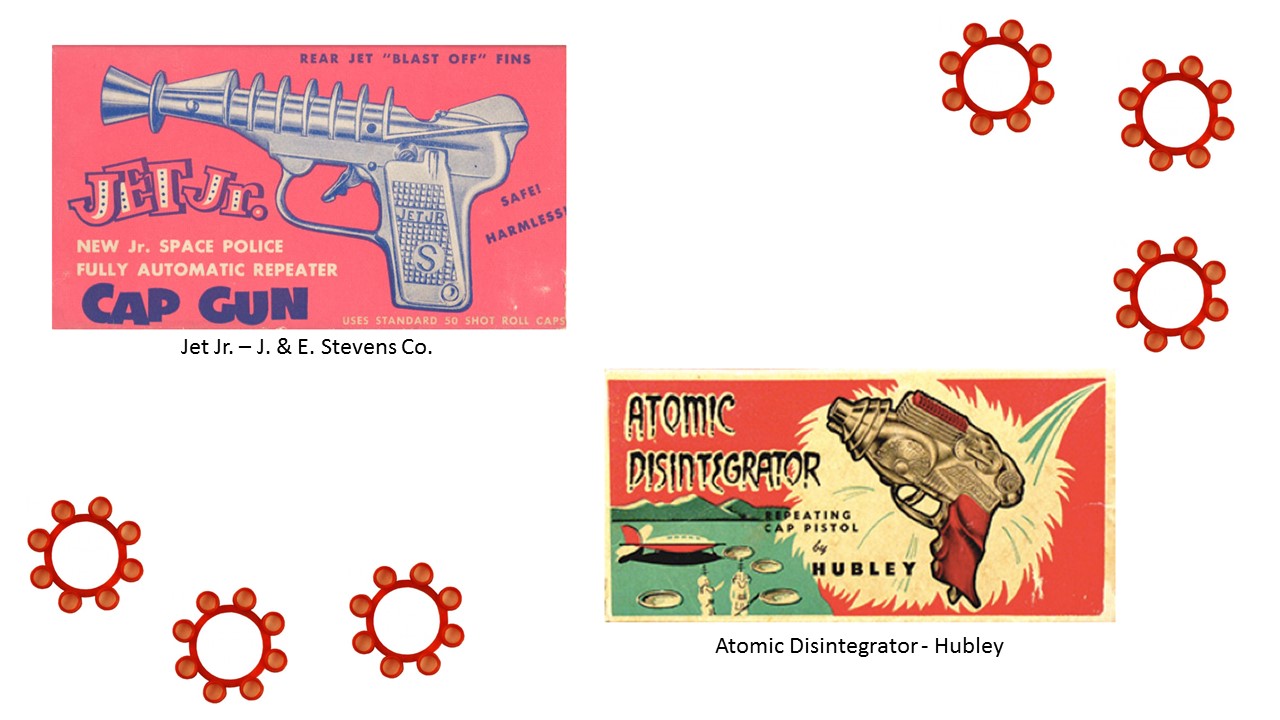
For generations children have been having a blast (puns) with cap guns. They can be found in all shapes and sizes as well as all types - pistols, revolvers, rifles, machine guns and even ray guns. If you were a kid with an imagination, there was a pop gun to match your particular made up adventure.

As collectibles, most cap gun collectors tend to go for the ones based off of famous characters such as The Lone Ranger, Roy Rogers, James Bond and more. If it was a popular "action" television show between the 1930's and 1950's or film, chances are fairly high that a cap gun (or some form of toy gun) was produced. Mind you, that's just the ones based on pop culture characters. There are perhaps double or triple (if not more) of non franchise related cap guns as well.

Since their inception, cap guns have been produced in die cast metal, plastic, and the die hard vintage collector's favorite, cast iron. Then of course there are the numerous companies which have come and gone over the decades who have produced some of the best cap guns to date; Hubley, Kilgore, Marx, Halco and Daisy (to name a few).

While many a collectors choose their favorite cap guns based on aesthetics or product license, there is another factor which shouldn't be overlooked - The caps of course.


You can't have a cap gun without caps. They're what give the gun that distinctive bang sound, a puff of smoke and that familiar scent. Caps have been produced in numerous different styles, which unfortunately limits which guns they can be used in.

The most popular form of cap is the roll cap. This in turn makes the guns that use them all the more popular.

The primary explosive in most caps is called Armstrong's Mixture. Taken from Wikipedia;

"Armstrong's mixture is a highly sensitive primary explosive. Its primary ingredients are red phosphorus and strong oxidizer, such as potassium chlorate and potassium perchlorate."

Yup - Means nothing to most of us beyond if it goes bang, we smile with glee.

In addition to roll caps, several manufacturer's have also produced ring caps which are common in revolver and / or rifle style cap guns. Each ring can hold anywhere from one to twelve, with eight being the most commonly found / utilized.

Though not commonly used, caps can also come in single row strips. These caps were far more common in the 1980's, and utilized for uzi type cap guns or other such automatic weapon style toys.

What makes pairing up caps with specific guns sometimes challenging is the fact that many cap gun companies didn't actually produce caps in house. Companies such as Buzz Henry, Stevens, Kenton, and even the larger Hubley and Marx never release caps. Instead, they relied on the already well established market of competitors and 3rd party manufacturers. In fact, there are probably more companies that produce caps than the actual guns. We're not sure if this was a result of far more licenses / experts being needed when working with explosives. Sounds pretty convincing as an argument though.

Despite being mini explosives, caps and cap guns have been determined as safe for use by product safety testers. With the exception of a burnt finger here and there on the paper roll caps, we can honestly say we've never had any accidents that resulted in anything beyond waving our finger in the air to cool it off.

As time has gone by, to make the guns aesthetically different from real guns many toy company's began developing their cap guns with bright orange tips at the end of the barrel. The downside to this was that many children would pry them off with a pair of pliers. Toy company's have also taken to producing the guns in fully painted bright color schemes. Whether these have helped to achieve the safety level intended is another story. However, this seems to be more so a problem with society, and not necessarily the guns themselves.

It would be impossible for even the most die hard toy enthusiast to nick the surface of the immense amount of cap guns that have been available since their inception in the mid 1860's. The largest collection in the world is currently denoted as belonging to Chuck Trois, former guitarist of Expressway To Your Heart. His collection is so massive he admits he doesn't even know how many he owns. If you're ever in Fredericksburg, Texas, stop by the 5,000 square foot museum where they are displayed.


As for the kids of this generation (and most likely beyond), they'll have to suffice with more diverse style toy guns. Ones that in essence are guns, but it's disguised to not be one...So shhh don't tell mom.

You know, ones such as the Fart Blaster from Thinkway Toys Despicable Me 2 line.

Yes, we live in a world where if you're going to play toy guns with someone else, then (one) it can't look like an actual gun, and (two) it has to make a grueling, disgusting fart sounds as opposed to live ammunition ones. After all, it's far more appropriate to teach our children to be offensive than promote any such form of violence.

P.S. The Fart Blaster is tons of fun. See you next year, Toy Box readers!

Click "HERE" to go back to the home page. For more posts related to this one, please click the labels below.

Marvel Comics, Marvel Mystery Comics (Timely Comics)


May 6 is Free Comic Book Day. As typical here at The Toy Box, that means we're dedicating the entire month to look at some of our favorite comic book series from yesterday. As is customary, we're only looking at series that have completed their run, so we're not looking at anything current. Sorry, folks. No Walking Dead just yet.

Marvel Comics
Timely Comics
1939

This is it, folks. This is where the era of the super hero all started. 1939's Marvel Comics, published by Timely Comics. Though it is technically considered to be issue number one, you won't actually find that anywhere on the cover or inside the pages.

The book featured The Human Torch, and Namor, The Sub-Mariner all under one cover. If that wasn't enough, it also featured characters that would become staples of the Golden Age era of comic books; Ka-Zar, The Masked Raider and The Angel.

"Wait a minute," you say. "How can this be accurate if this comic is from Timely Comics?" Let's take a trip through history for that answer.

Timely Comics was the first publishing "arm" of publisher Martin Goodman. Though Goodman used the Marvel branding on several books, most notably by labeling books with, "A Marvel Comic", it wouldn't be until 1961 that Marvel Comics was officially adopted as the companies name / brand.


Though the book is a great read, you're only source for this is probably going to be a digital copy online. Comic guides value the book's worth at over $500K, Probably not something many of us could part with on a whim.

Marvel Mystery Comics
Timely Comics
1939 - 1949

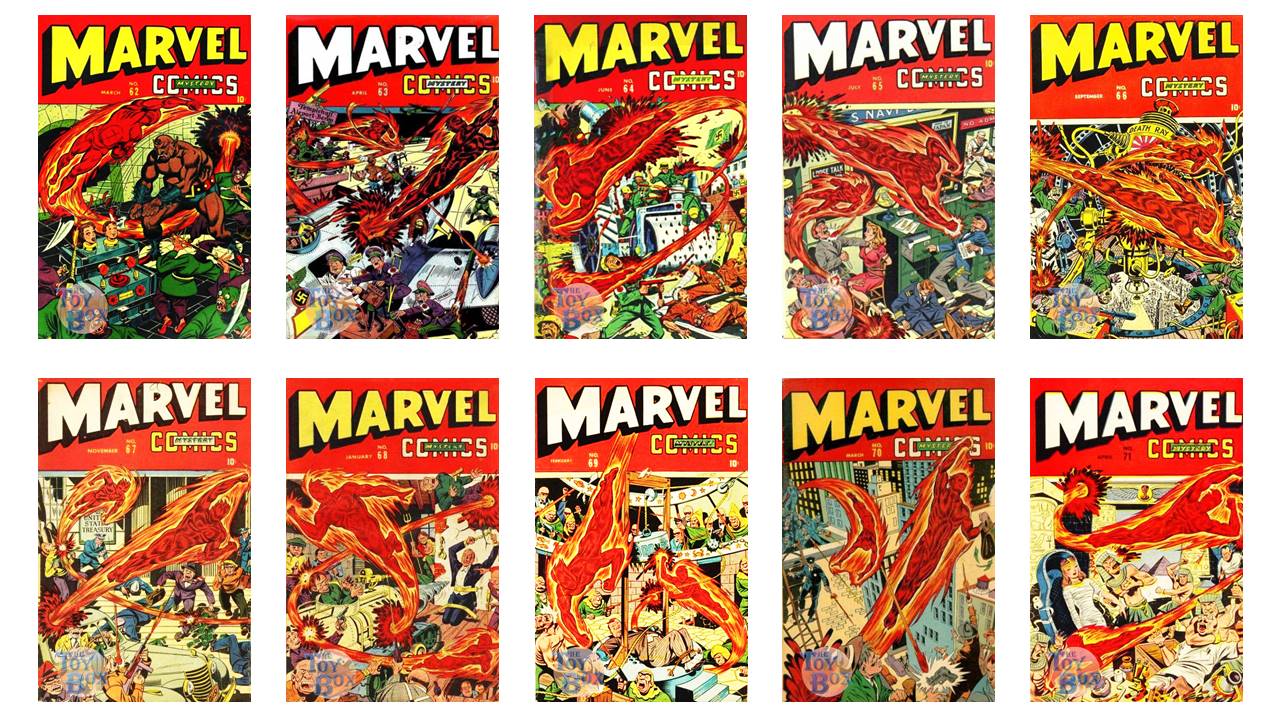
Marvel Mystery Comics is the official continuation of the title. The book started with issue number two in 1939, and picked up with the now famous Human Torch and Namor characters. Over time, other characters would also make appearances - Most notably was Captain America in issue 81.

Due to the period in which these books were published, you will notice that they lean heavily on WWII themed stories which feature the heroes battling it out with Nazis and the Japanese. As such, in today's perspective, the can seem, shall we say, not so politically correct. Still, if you can appreciate the stories for their period "correct" narrative, they are still good reads.


Click "HERE" to go back to the home page. For more posts related to this one, please click the labels below.

Disney Animated Classic Movie Posters (Disney)


Today would have been Walt Disney's 115th birthday were he to still be with us - Which he is if you believe the urban legend that he's cryogenically (apparently not a real word) frozen somewhere underneath Disneyland. In celebration of the day, we've compiled all the posters from the famous library of Disney Animated Classics.

Mind you, this list is heavily disputed among Disney fans. Go to one web site, and you'll see a list of 52 movies. Head to another, and that person will profess there are 58, and so on, and so on. We'd be lying if we said that we honestly knew which list was right. Suffice to say, ours comes from IMDB - Which like all the others is also disputed in the comments section. We're sure if someone finds this post online that it too will be disputed.

Since we're going chronologically, it's fairly safe to say that the list is accurate from Snow White, which was Disney's first animated classic film, through The Aristocats, which was the last classic to be approved by Disney prior to his death. From there, all bets are off. However, we're fairly positive that the list is accurate at least up until 1999's Fantasia 2000. It seems at this point is where most lists are disputed. Some claim Dinosaurs is a Disney Animated Classic, while others swear it isn't....We don't honestly care know. Suffice to say if you like the movie, and want to consider it one - Knock yourself out.

So, for what it's worth, here's what we have - Again, based on IMDB;

Snow White and the Seven Dwarfs (1937)*Pinocchio (1940)

Fantasia (1940)*Dumbo (1941)

Bambi (1942)*Saludos Amigos (1942)

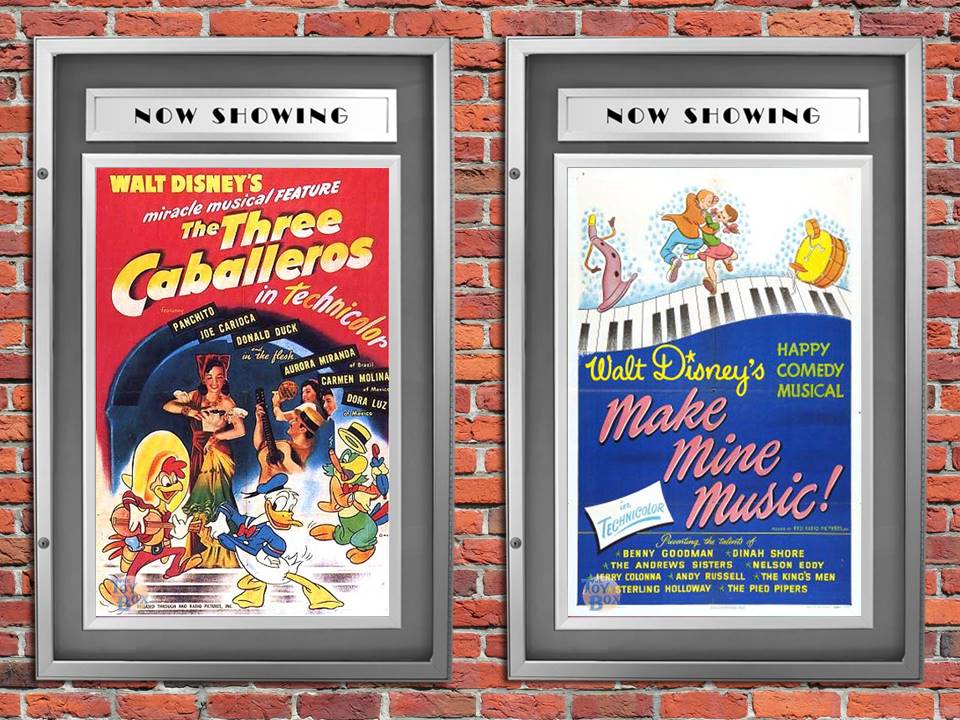
The Three Caballeros (1944)*Make Mine Music! (1946)

We, like all other Disney fans out there have our favorites, and our dislikes.The 1942 period beginning with Saludos Amigos, and leading through the 1948 released Melody Time definitely falls under the dislikes category. These films, while a fine piece of animation (and live action), simply don't hold up well for us in terms of general story telling. They rely too heavily on skits, and music to drive the films. More importantly - They're just so boring - Again, personally speaking.

Fun and Fancy Free (1947)*Melody Time (1948)

Though it's true that The Adventures of Ichabod and Mister Toad continues the tradition of building a film around skits, we actually really enjoy this one. Both main features of the film are strongly written, and are simply fun to watch. Fortunately Disney opted to return to fairy tales, and full length stories with its following entry, 1950's Cinderella.

The Adventures of Ichabod and Mister Toad (1949)*Cinderella (1950)

Alice in Wonderland (1951)*Peter Pan (1953)

Here's a fun bit of history for you. Lewis Carroll's Alice in Wonderland is actually in public domain. Yep, if you want to create your own Wonderland story, and ship it off to the local printing press, or big screen, you're in your legal rights to do so. Neat!

Lady and the Tramp (1955)*Sleeping Beauty (1959)

One Hundred and One Dalmatians (1961)*The Sword and the Stone (1963)

The Jungle Book and The Aristocats would be the last two films personally approved by Walt Disney. Walt passed away of lung cancer in 1966 at the age of 65 - A result of smoking pipes and unfiltered cigarettes for decades. Though it's true that Walt wouldn't be with us today as he would have been well over a hundred years old, it would have been amazing to see the direction he took the company had he stuck around for a few more decades - Not that we didn't get great films in his absence (Our personal favorite came out in 1977 starring a now famous yellow bear).

The Jungle Book (1967)*The Aristocats (1970)

Robin Hood (1973)*The Many Adventures of Winnie the Pooh

The Rescuers (1977)*The Fox and the Hound (1981)

The 1980's brought with it a new style of Disney film - The beginning of the computer age. The Black Cauldron is noted for being not only the first Disney Animated Classic to incorporate computer graphics, but also the first to be rated PG, and have no songs sung by anyone. It's a classic unto itself, but definitely threw parents for a loop when it debuted in 1985. Let's just say it wasn't the Disney film many people were expecting.

The Black Cauldron (1985)*The Great Mouse Detective (1986)

Oliver and Company (1988)*The Little Mermaid (1989)

The Rescuers Down Under (1990)*Beauty and the Beast (1991)

The Rescuers Down Under is the first and only sequel to be allowed into the Disney Animated Classic lineup. All others to date have either been direct to video or made for TV under the Disney Movie Toons emblem.

Aladdin (1992)*The Lion King (1994)

Pocahontas (1995)*The Hunchback of Notre Dame (1996)

Hercules (1997)*Mulan (1998)

Tarzan (1999)*Fantasia 2000 (1999)

Not actually released in 2000, but rather December of 1999, Fantasia 2000 was a boast from Disney to remaster the original while adding in sequences that were intended for the original 1940's released film. It included new segues featuring the likes of Steve Martin, Angela Lansbury, Penn & Teller, James Earl Jones and more. Its biggest feature was that it was being presented in IMAX theaters. To many Disney purists, Fantasia 2000 ended up being what the Special Editions of Star Wars are to many - A horrible nightmare.

Now we come to that highly controversial Dinosaur from 2000. Mind you, it's not controversial for the film itself, but rather the point in Disney Animated Classic film history where the arguments of whether or not the various films belong in the lineup or not. We don't honestly know, so let the arguments begin in the comment section.

Dinosaur (2000)*The Emperor's New Groove (2000)

Atlantis: The Lost Empire (2001)*Lilo & Stitch (2002)

Treasure Planet (2002)*Brother Bear (2003)

Home on the Range (2004)*Chicken Little (2005)

Meet the Robinson (2007)*Bolt (2008)

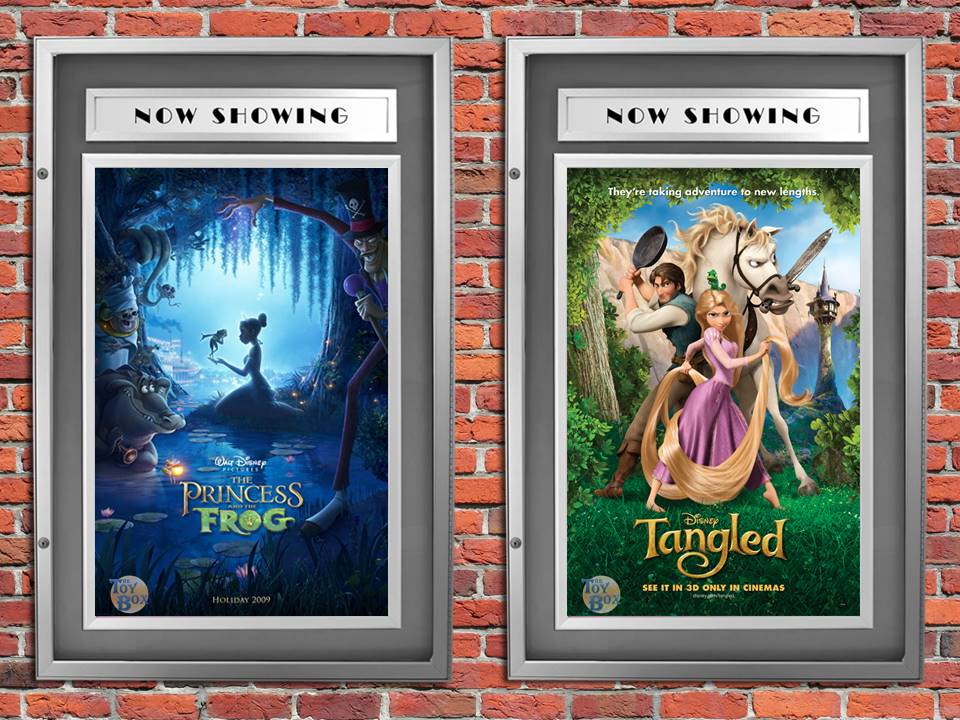
With three films in a row strictly focusing on computer animation, the world of traditional animation seemed bleak to return. That was until Disney announced The Princess and the Frog. Not only did this continue the popular hand animated style, but also introduced fans to its first non-white princess.

The Princess and the Frog (2009)*Tangled (2010)

Winne the Pooh (2013)*Wreck It Ralph (2012)

Sadly it was a short live victory as Disney would later gut its hand animation department in 2013, ceasing any plans to continue in the "outdated" style. Computers are simply faster, easier, and cost less.

Frozen (2013)*Big Hero 6 (2014)

Zootopia (2016)*Moana (2016)

Disney has announced two projects in the works which are speculated to be a part of the Disney Animated Classic cannon - Moana (2016) and Gigantic (2018). These films keep in time with the computer animated features we have been receiving over the past few years, and it's most likely safe to say that this is the way it will be until the next best thing in animation is developed.

Gigantic (2018)

As so many Disney films have said in the past, this is "The End". We hope that you enjoyed this look at all these classic posters. Whether or not they truly do fall into the Disney Animated Classic lineup is another question - One we're sure will be debated for years to come.

Click "HERE" to go back to the home page. For more posts related to this one, please click the labels below.