
September 2010 Recap
Below is a recap of all the post we've covered in September 2010. If you missed any, or simply want to see them again, click on each "title" to be taken directly to that post. As always, thanks for reading.
Star Wars: Power of the Force
Transformers 1985
Click "HERE" to go back to the home page.
Transformers 1985 (Hasbro)
By 1985, Transformers was a household name. Kids were watching the cartoons, collecting the toys, reading comic books, and more. The second series of toys was much larger than the prior series, and though the majority of primary characters were already released, Hasbro had several secondary ones in the wake which were produced for the series.
Once again there were three sizes of characters; large, medium and small. The large and medium were packed in boxes with Styrofoam/cardboard form fit padding, while the small were released on bubble cards.


The 1985 series included the highly popular Dinobots.

Sludge, Swoop

Snarl

Tracks, Skids

Red Alert, Blaster

Perceptor

Powerglide, Cosmos
There were two seperate mail away promotions. The first was the three pack Omnibots which were packaged in a medium size box.

Overdrive, Camshaft, Downshift
The second series of mail away figures was the Powerdashers. The way it worked was that by ordering one, you essentially joined a mail away club. Over the next few months, the next two figures were sent (individually) to members. Each Powerdasher was sent in a clear plastic bag inside of a brown box.
The characters had no names, and were known simply by there vehicle forms.

Car, Drill, Jet


Ransack, Venom
Series two was the first to see the release of Triple Changers. These were Transformers that had two vehicle forms, and one robot form. A perfect example of this is Astrotrain who can transsform from a robot to a train to a space shuttle.

Dirge, Ramjet

Bombshell, Shrapnel
The Constructacons could be combined together to form Devestator.

Hook, Ong Haul, Mixmaster
For those who wanted to get all the Constructacons in one fell swoop, Hasbro released the Devestator set as one piece.

Transformers continues today, but the first generation of toys officially ended in 1990. Today the classic Gen1 figures are highy sought after by collectors, and incredibly difficult to come by mint in the packages, or on cards.
Click "HERE" to go back to the home page. For more posts related to this one, please click the labels below.
Star Wars: Power Of The Force (Kenner)
1985 was a sad, sad year for Star Wars fans. It would be the last year for over a decade that Star Wars merchandise would be released in abundance. To true fans of the Saga, Star Wars never died. However, for the majority of consumers, no new movies meant no interest.

Despite its very limited run, without a doubt the Power of the Force line of figures to date are some of the very best. Kenner reached deep into the Star Wars films and pulled out numerous unique and wonderful characters to sculpt.
Granted there was a fair share of figures from the prior lines, but at this point it is conceivable that this was Kenner’s last attempt at getting rid of overstock - Mainly because the supply was very limited, and the figures themselves seemed rather random.


The Power of the Force line brought the total figures produced to 92. This in turn saw the production of one final card backer. On the back of the card was an advertisement for what would become the most collectible item in the vintage Star Wars line...The collectible coin.
Worth noting is that the Yakface figure was never released in the United States, but yet many fans and collectors in the U.S. don't consider a collection complete until it is obtained.

Kenner produced a very limited amount of vehicles to accompany the Power of the Force line. A total of five to be exact, and only one were actually seen on screen. The other four seemed a rather cheap attempt from Kenner to soak out the last bit of change from consumers on a line that would soon be cancelled.
On the bright side, these vehicles were only released in the United States. Other countries received repacked vehicles that had been released in prior series, such as the X-Wing and TIE Fighter.

As stated above, the coins would become the most collectible items in this line. So much so that loose figures without the coin are worth considerably less than they would be with it.
What makes these coins so rare is that the bulk of them were only available via a mail in offer that was made available towards the tail end of the line. Because of this, very few complete sets are known to be in existence.

A total of sixty-three silver coins were produced (though only 62 were made available to the public) with a few also being minted in gold, and one being minted in bronze. Worth noting is that all the carded figures came with their respective coin with the exception of the AT-AT Driver and Nikto who were packaged with a Romba (the Ewok) coin. Despite the many coins that were produced (between the carded figures and mail away coins), these two never got their own coin.
Depending on the production run, there were also variations to the backs of the coins, three of which are known to exist.

For those lucky few collectors in 1985 who sent in enough proof of purchases in one lump sum, and a written request letter, Kenner actually did send full sets that were hand picked from the warehouse. The coins were then mailed in plastic protective sleeves - an act which was much appreciated by collectors looking to keep their coins for a lifetime, and possibly even pass on to their families.
It really was a sad time for Star Wars fans. As merchandise slowed down, and eventually stopped coming at all, it was clear that we'd have to find our Star Wars fix elsewhere. It didn't help matters much that Kenner had produced several prototypes and even began advertising for figures that never made it to store shelves.
Fortunately Star Wars received a huge revitalization in the public's eye in 1997, and the toys haven't stopped coming since. But, that's a post for another time...
Click "HERE" to go back to the home page. For more posts related to this one, please click the labels below.
August 2010 Recap
Below is a recap of all the post we've covered in August 2010. If you missed any, or simply want to see them again, click on each "title" to be taken directly to that post. As always, thanks for reading.
G.I. Joe Package Inserts
G.I. Joe 1987
G.I. Joe Comics
Click "HERE" to go back to the home page.
G.I. Joe: A Real American Hero (Marvel Comics)

Today, we're going to take a look at the Marvel Comics run.
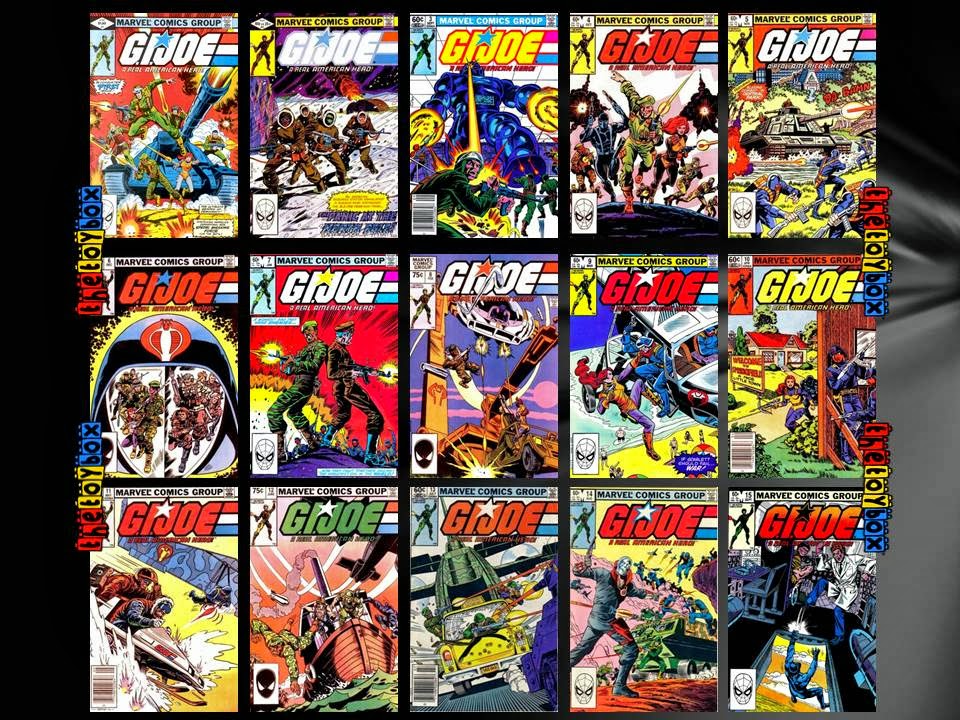 A Real American Hero (Main series)
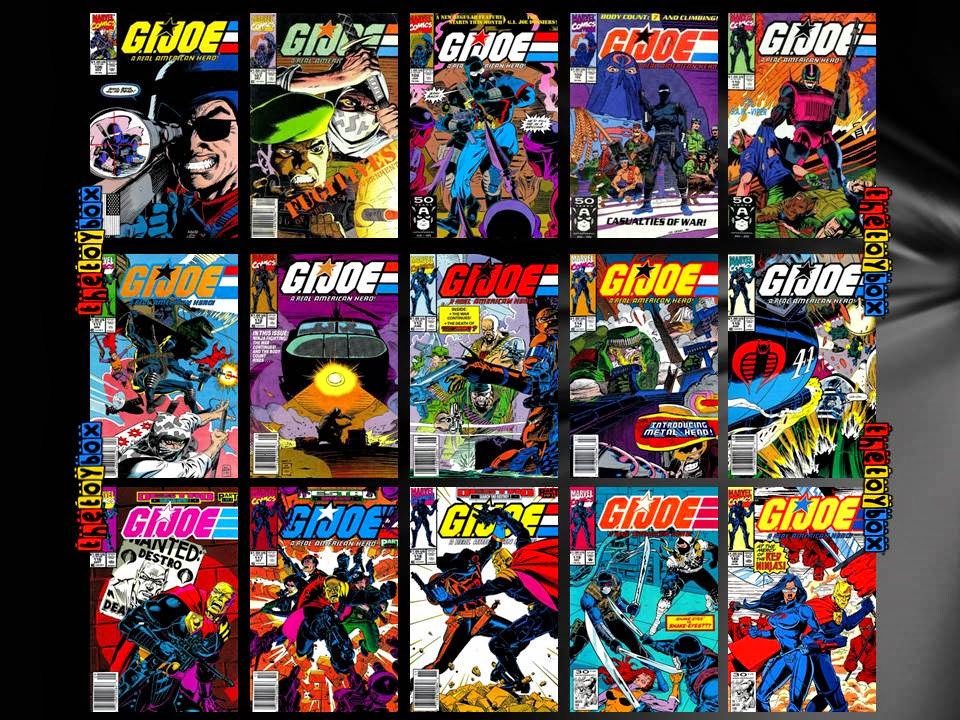
Hasbro re-launched their G.I. Joe franchise with G.I. Joe: A Real American Hero. It was supported by a Marvel Comics series. It was unique at the time in that it was a comic book series that was promoted on television commercials which also supported the toy line. This 155-issue series is considered to be one of the longest-running comic book tie-ins to a toy line. Much of its success is to be credited to Larry Hama, who wrote the entire series save for a few issues with guest writers. Rather than treating the stories as a mere promotion for the toys, Hama wrote the series with seriousness and infused it with doses of realism, humor, and drama. Other than Transformers, no other series was able to duplicate its success. Notable artists include Herb Trimpe, Ron Wagner, Rod Whigham, and Marshall Rogers.

Issue #21 became a fan-favorite, not only because the Cobra ninja Storm Shadow was introduced, but that issue also became a prime example of comics' visual storytelling power, having no dialogue, only pictures.
A number of differences existed between the comic book and the animated TV series. Certain characters who were very prominent in the comic book, such as Stalker, were featured very little in the cartoon, while characters who were less prominent in the comic book, such as Shipwreck, were very prominent in the cartoon series. Another difference was that in the comic book featured a romance between Scarlett and Snake-Eyes, whereas in the cartoon, a romance between Scarlett and Duke was hinted at instead (most likely due to the differences between writing for a comic book audience and writing for an animated series). The most notable difference between the comic and the cartoon, however, is in its handling of combat. While the cartoon showed that nearly every soldier in every battle survived (for example, many shots of different aircraft being shot down were shown to have its pilot escape in a parachute), the comic did not shy away from mass character deaths; for example, issue #109 included the deaths of a large number of Joes, including fan-favorites like Doc, Breaker, and Quick-Kick.




In 2001, with the success of Devil's Due Comics run of G.I. Joe, Marvel Comics collected the first 50 issues in five trade paperbacks, with ten issues in each book. All covers for the trade paperbacks were drawn by J. Scott Campbell. Marvel will not publish the rest of the series, because Hasbro has purchased the rights to the comics. Hasbro has since released reprints of some issues with some of their action figures.
G.I. Joe Yearbooks
The four Yearbooks (1985-1988) collected some previous stories, summarized events, etc. and, aside from the first Yearbook (which re-printed the seminal first issue), published new stories that tied into current events in the main title.

 G.I. Joe: Special Missions
The success of the main title led Marvel Comics to produce a secondary title, G.I. Joe: Special Missions which lasted 28 issues, with Herb Trimpe as the artist for nearly the entire run, with Dave Cockrum providing pencils on several issues. Spinning out of issue #50 of a story in the main title, the series featured more intense violence and a more ambiguous morality than the main title, while the enemies were conventional terrorists as well as Cobra itself. The first four issues, as well as the backup story from issue #50 of the main title, were later republished as a trade paperback.


Order of Battle was a four-issue comic series that reprinted the data found on the action figures' file cards with some edits and all-new artwork of G.I. Joe characters by Herb Trimpe. Published in 1987, the first two issues featured G.I. Joe members while the third issue focused on the Cobra Organization, and the fourth featured various vehicles and equipment used by both organizations. The second issue caused some controversy when it erroneously listed Sylvester Stallone's Rocky Balboa character as a member of G.I. Joe. While negotiations had taken place, concerning the character's membership on the team, the deal had fallen through. The third and fourth issues contained a retraction stating that Rocky Balboa was not and had never been a member of G.I. Joe. The trade paperback edition of the series removed mention of the Rocky character entirely.
G.I. Joe Special
Shortly after the final issue (which was released in December 1994), a G.I. Joe Special #1 was released, with alternate art for issue #61 by Todd McFarlane.

G.I. Joe Comic Magazine
The first 37 issues of the main series were republished in the thirteen digests known as G.I. Joe Comic Magazine.


Tales of G.I. Joe
Tales of G.I. Joe reprinted the first fifteen issues of G.I. Joe on a higher quality paper stock than that used for the main comic.


A four issue limited series that teamed-up the Joes with the other popular property of the 1980s, Transformers. The Joes and the Autobots must join forces to stop the Decepticons and Cobra from destroying the world. The story suffered from the need to have the events of the limited series reflect the events of the main G.I. Joe and Transformers titles published by Marvel Comics at the time. However, while there were references in the Transformers ongoing series to the events of the limited series, the G.I. Joe ignored it completely, as writer Larry Hama didn't consider it to be canon, though towards the end of the ongoing G.I. Joe series several Transformers characters appeared in the G.I. Joe title as a prequel for the upcoming Transformers: Generation Two comic. The issues made reference to the limited series. A trade paperback later collected all four issues.
That’s a whole lot o' Joes
And there you have it - The Marvel run of G.I. Joe.
Click "HERE" to go back to the home page. For more posts related to this one, please click the labels below.
G.I. Joe: A Real American Hero 1987 (Hasbro)
Here it is, the long awaited updated version of the 1987 G.I. Joe toys. This post has been one of the longest ones in the works as we updated it from our prior photographs to this all new, mint in package edition. It's been a chore to say the least.
 Much like an good Joe series, the figures are the heart and sole of the 1987 series, bringing with it several figures from the highly frowned upon G.I. Joe The Movie from Sunbow, as well as figures from the (at the time) all new DIC television series. It may seem like a mish mash of figures, but it worked very well at the time, and today stands up as a solid line of figures in the Joe's plastic history.
Seventeen basic figures were produced for the line, elven of which were Joes, with only six being Cobra figures. Way to be outnumbered there, snakes!


 Hasbro also released the very intriguing, but poorly executed Battle Force 2000 sub series. The figures weren't too bad, but the vehicles which promised a "build a base" feature really drove the nail in the coffin for what could have been a solid Joe branch from the main line. See below for more details on that (vehicle section).
The group represented a high tech Joe squad that utilized experimental weapons in battle. Though six were produced in 1987, the team actually consists of seven members. The seventh figure would be released later in the G.I. Joe line (1989 AKA Series 8).


The Marauders included Red Dog, Taraus and Mercer. The Cobra-La set included Golobulus, Nemesis Enforcer and a Royal Guard. Sadly a Pythona figure was never produced for the line - Something that to date still hasn't happened despite repeated fan requests of Hasbro.
No good Joe line is complete without mail away figures. The mail away figure Starduster unfortuantely never found much popularity during its initial release, and was soon discarded for a much more popular mail away...

 ...Steel Brigade. It's the figure that boasted that, "You can be the next Joe!" Kids went nuts!
Each order form included several boxes that could be checked off, each of which picked your character's stats. Was he an explosive expert? A ninja? Possibly a medic? What about an explosive ninja medic? Not only that, but you gave the figure its own unique name. If that weren't enough to make any kid go bananas, Hasbro would print up your own unique file card.
The figure was so incredibly popular that six different versions exist. The variations consist of different belts, chest straps, and holsters. Out of the six versions, the rarest is the gold headed version. This figure, while hard to find, is easy to spot because not only is the helmet a different color, but so is the clothing.
These days a "standard" Steel Brigade figure sells for About two hundred dollars, while the gold helmet edition goes from four to five hundred.
Two accessory packs were released in 1987. The first continued the numbering from the battle gear "series" with number five, and the second was an all new Vehicle Accessory pack which contained various bombs and rockets.

New to the world of Joe was the motorized Action Packs. Each wind up toy had not only a crank to perform its "motorized" action, but also an on/off switch so that you could crank it, and then play at your leisure. The packs are incredibly easy to find loose, but most don't contain all the individual stickers that came packed in.

As usual, the series was rounded off with a fair amount of vehicles of all sizes and price ranges, some of which were packed with exclusive figures.


If you thought the kid down the street with the USS Flagg was a spoiled brat, his cousin down the block with the Defiant Space Vehicle Launch Complex must have been the Mayor of Spoiled Brats. This massive playset, while not as large as the Flagg boasted more moving parts and fun than the Flagg ever could.

The eqaully impressive Mobile Command Center which folded out into three sections/levels was also released with the 1987 assortment.

Then there were the Battle Force 2000 vehicles which drew kids in with a heartbreaking promise that the vehicles could be combined to build the massive Future Fortress. It was a lie!
 Yes the parts could be used to build the fortress, but none of them actually hooked together. Instead, you just put each piece next to the other, and created a square "parking lot" of part of the vehicles. It was such a let down to kids.
On their own the vehicles are much more impressive as each breaks apart into two pieces, half of which was used for the "base". Unfortunately the sub series never really took off the way that Hasbro intended, and with the exception of the one final figure and vehicle released in 1989 the line was silently scrapped, which made way for more sub lines such as Tiger Force and Night Force, but those are part of a whole new series that we'll talk about at a later date.
Until then, we hope you've enjoyed our updated look at G.I. Joe 1987!
Subscribe to:
Posts (Atom)