
May 2010 Recap
Below is a recap of all the post we've covered in May 2010. If you missed any, or simply want to see them again, click on each "title" to be taken directly to that post. As always, thanks for reading.
Teenage Mutant Ninja Turtles Comics
Super Powers
Click "HERE" to go back to the home page.
Super Powers (Kenner)
Batman, Superman, Wonder Woman, Lex Luthor, The Joker - All of DC's major cast of characters shaped what is considered to be one of the most thorough and complete lines of super heroes to date. Mainly because these days it seems that every super hero has their own line of toys - Specifically when a new movie hits theaters.
But, back in 1984 when Kenner approached DC Comics, there weren't too many comic book movies around, at least, not any good ones. Instead, Kenner wanted to produce a line of toys based on the height of comic book popularity...At least, the height for that particular decade.
Between 1984 and 1986, Kenner produced thirty-three figures for the now highly collectible line across three series of figures. At the time, this was an incredible amount of figures to produce in such a short period of time. What makes this series even more special to collectors is that Kenner didn't skimp on the detail. One look at each figure, and fans could easily identify them.
Series one contained a major lineup of "main" characters both good and evil from the DC universe.

Batman, Robin, Hawkman

The Joker, The Penguin
Prior to the second series launching, Steppenwolf, who would be available in the second series was released as a mail away exclusive for five proof of purchases off the back of series one carded figures.
Series two launched in 1985 with eleven new figures.

Green Arrow, Dr. Fate, Darkseid

Parademon, Desaad, Mantis

Both series one and two offered collector's the chance to get the excluisve mail away Clark Kent figure. For five proof of purchases, you would get; the figure, a poster (signed by the heroes), the first issue of the fan club magazine (with an offer to join the club), a patch, and a sticker.
When series three was released in 1986, the line was dwindling in popularity. Despite its strong launch, and loyal fans over the prior two years, the children of the 80's were quickly growing up, and action figures were becoming a part of their pasts. Despite plans for a forth series, these next ten figures were the last in the series.

Cyclotron, Orion

Mr. Freeze, Tyr
Several vehicles were released between series one and two, and while some vehicles were planned for series three, due to the sudden cancellation of the line, they were never produced. A box mock up and an actual prototype for the All Terrain Trapper exist, though it is unknown were these items currently are, or who's collection they are in.

Supermobile, Justice Jogger, Delta Probe One

Lex-Soar 7, Kalibak Boulder Bomber

While two playsets were planned for the series, only one was ever released; the Hall of Justice. The other playset, Tower of Darkness, was scheduled to be released during series three. Like the vehicle, the All Terrain Trapper, a prototype does exist, but it is unknown where that prototype is today.
To help boost sales, in 1985, Kenner and DC combined forces with legendary cartoon creators Hanna-Barbera who produced the series The Super Powers Team: Galactic Guardians. To date it is considered to be one of the most faithful adaption of these beloved characters.
Sadly, while beloved by true comic book fans, it didn't click with most children who were moving on from their Star Wars and He-Man years on to more adult themed things. The series lasted only eight episodes. Fans of the series can relive their fond memories via DVD as the entire series was released in 2007.
To date, Super Powers is one of (if not) the best super hero based toy lines. Yeah, they had buttons on their backs for "super moves" that made them a whole heaping fun to play with, but overall, back then, and even these days, they're just really cool to look at. It's no wonder that the Super Powers toy line is so sought out by collectors today. It's just that good.
Click "HERE" to go back to the home page. For more posts related to this one, please click the labels below.
Teenage Mutant Ninja Turtles Comics (Mirage)


In the years since the Teenage Mutant Ninja Turtles were created, Michelangelo, Leonardo, Raphael and Donatello have become a classically comical part of Americana.
Kevin Eastman and Peter Laird, the creators of the Turtles, published their first black and white TMNT comic book with just $1,200 in 1984. With tons of work and a plethora of good fortunes, they've seen the Turtles go from an underground hit to a world-wide phenomenon. It's been a wild and crazy ride, to say the least!
After a long day of work way back in 1983, Kevin and Peter were relaxing at Laird's house watching television and sketching. "We got real punchy!" Peter explains, and they started drawing cartoons to amuse themselves. At the time Peter was doing editorial illustration and advertising art with some success while Kevin was working as a short-order cook and drawing comics in his spare time. As the evening evolved, Kevin eventually drew a bipedal turtle with Nunchukus strapped to its arms and called it a "Ninja Turtle". Peter, aware of a nifty idea when he saw one, asked "Why not a teenage mutant ninja turtle?" and thus the legend was born.
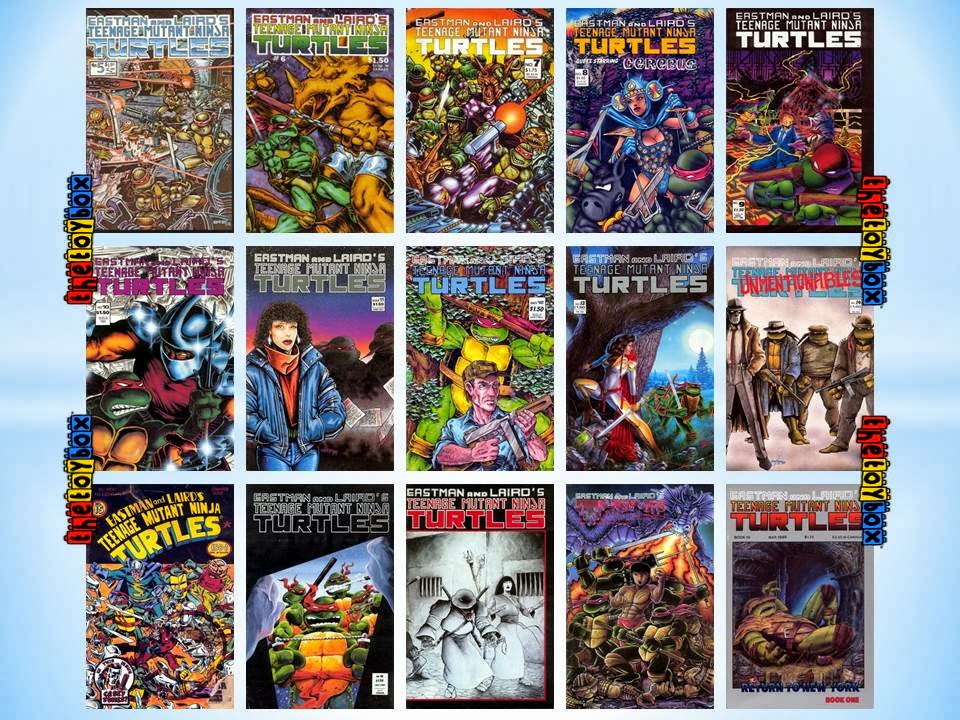
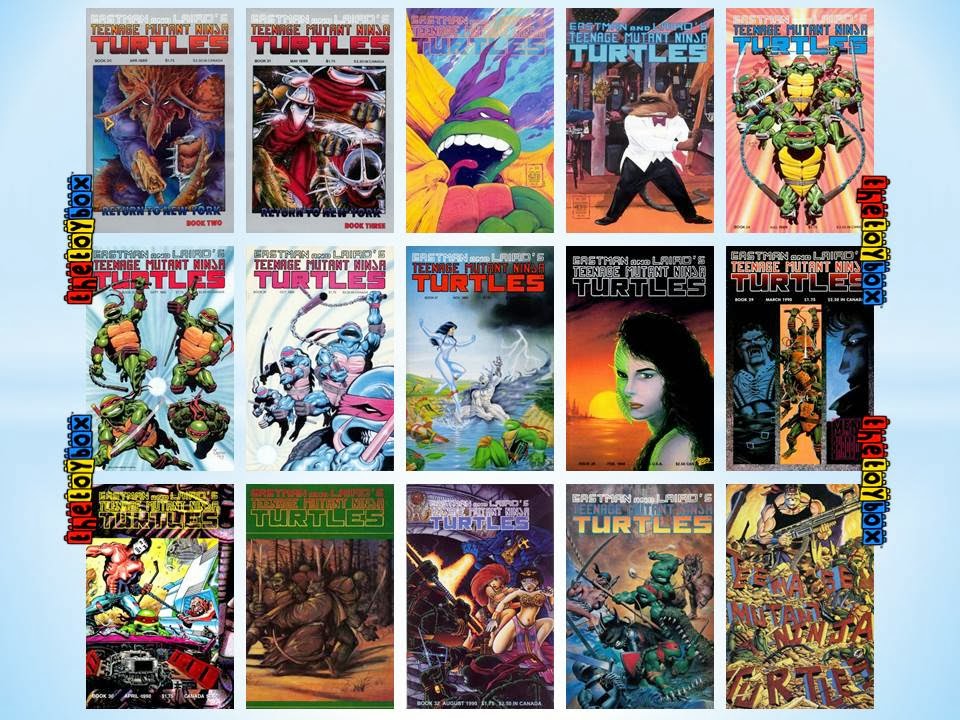

"We had all the Japanese fighting methods, but we didn't want to make up Japanese names because we thought they'd seem too strange to American readers." explains Kevin. "So we decided to go in the opposite direction and used distinctly European names. We both had studied art history, so we picked Raphael, Donatello, Leonardo and Michelangelo."


With the story written, Kevin and Peter began doing the artwork. Since the creative duo had similar styles, they were able to switch tasks back and forth. Some pages were penciled by Kevin and inked by Peter, some pages were penciled by Peter and inked by Kevin. Once the complete comic book was finished, they set out to find a publisher for it. Much to their dismay, the guys had no luck finding someone willing to print the title.


"We expected to sell them all as single copies through CBG." Peter remembers. "Instead, we got calls from distributors and learned about the wonderful world of discounts."


The first issue of the TMNT went to the printer on April 1, 1984... no foolin'! The printer finished the job in time for Peter and Kevin to debut the title at a comic book convention in Portsmouth, New Hampshire on May 5. Oddly enough, the printer hadn't printed the Turtle comic in the usual comic book format. TMNT #1 was an over-sized book.

"We'd gone to a printer (who knew nothing about printing comics) with a locally produced TV schedule giveaway." Kevin commented. "We told him, 'This is what we want: a colored stock cover and black and white newspaper inside.' We never thought to specify size, so he printed the issue in the same dimensions as the TV schedule giveaway we used as a sample!"


"When we created the Turtles, we wanted to spoof the world of super hero characters and poke good natured fun at the heroic but not-so-funny characters that dominated the business." said Peter. "The Turtles are fun heroes with an attitude. Basically, they act and think like average teenagers."

It's a formula that has worked well!
As the popularity of the comic grew, attention outside of the comics industry flourished. As stated above, the first issue of the TMNT had an original printing of only 3,000 copies, but by the time Turtles' licensing agent Mark Freedman came aboard, the comic was selling over 125,000 copies (making it perhaps the most successful self-published B&W comic in the USA.) Mark caught wind of the Turtles thanks to Palladium's TMNT RPG book and was excited by the look and attitude of the characters. Believing that he could expand upon the Turtles' success, Mark contacted Peter and Kevin.


Click "HERE" to go back to the home page. For more posts related to this one, please click the labels below.
April 2010 Recap
Below is a recap of all the post we've covered in April 2010. If you missed any, or simply want to see them again, click on each "title" to be taken directly to that post. As always, thanks for reading.
Mattel LED/LCD Games
The History of Handheld Gaming
Click "HERE" to go back to the home page.
The History Of Handheld Gaming
Step aside consoles! Move over arcades! We want our games to travel with us! And, so they have since the late 70's!
From old skool LED all the way up to 32 bit systems, handheld games have evolved from the most primative technology to far surpassing videogame standards of the 80's and early 90's.
But, where did it all begin, and how far exactly have we come...

The idea of handheld video games with interchangeable cartridges wouldn’t take hold for about another decade, but Mattel managed to pry video games away from quarter-swallowing arcades and dim televisions with their successful line of LED-based, single-game handhelds. Most people today will remember Football, but the company also released the creatively-titled Basebal and Basketball, as well as the non-sports titles Missle Attack, Armor Battle, and Sub Chase. Mattel also managed to jump on the retro-chic bandwagon, re-releasing Football and Baseball in 2000.


Milton Bradley, a company then better known for Hungry Hungry Hippos than video games, has the distinction of being the first to introduce a handheld video game console with interchangeable cartridges with its Microvision. The system had only a handful of games and was plagued with problems from the start, including a 16x16 pixel LCD screen that was prone to rotting and cartridges that could be permantly damaged by even a relatively small static charge. Sounds like the makings of a real collector's item, if you ask me.

Upping the ante from Mattel’s LED handhelds, Nintendo introduced their first Game & Watch handheld in 1980 and would go on to produce dozens more throughout the decade, offering a small glimpse of what was to come from the company. As the name suggests, the handhelds featured a clock and alarm but the real attraction was the games, which included titles like Donkey Kong, Mario Bros, and Balloon Fight.

It’s almost impossible to understate the impact of Nintendo’s Game Boy. The original Game Boy, in its various incarnations, is the most successful video game system ever -- handheld or otherwise. Part of its success is likely due to its reasonable price ($109 US at launch), but most of it is a result of the games and, in particular, the drop dead brilliant move of bundling Tetris with the system.
The fact that a system with a blurry, green screen and fairly lackluster graphics compared to its competitors was as successful as it was should forever serve strongly in support of the argument that it’s the games that make the system, not the hardware.
Nintendo would make some improvements to the design over the years, releasing the slimmer Game Boy Pocket in 1996, which replaced the original’s green screen with a regular grayscale display, and the Game Boy Light, which added a backlit screen but was unfortunately only available in Japan.

The first of many challengers to the Game Boy was Atari’s Lynx, co-developed with Epyx and released in 1989. The system had far better graphics than the Game Boy, in some cases riviling the console systems of the time, but it was big and much more expensive than Nintendo‘s affordable unit. Atari redesigned the unit in 1991 but Atari’s marketing efforts proved to be no match for Nintendo’s, who were already well on their way to dominating the field for years to come.


NEC managed to produce one of the most technically impressive handhelds with its Turbo Express, which was actually a portable version of its console system, the Turbgraphx 16 (a rival to the Sega Genesis and Super Nintendo). The Turbo Express was about the size of a Game Boy but had a sharp active-matrix color display and could even be used as a portable TV with an optional tuner. The downside was, of course,the price which, at $299.99US, seemed to aim the device at a niche market that didn’t yet exist -- the (portable) gaming enthusiast.

The most successful of the various Game Boy challengers was Sega’s Game Gear which, like the Lynx and Turbo Express, had a color screen. But unlike those systems managed to keep the retail price down to a fairly reasonable $149. The Game Gear benefited from Sega’s advantage over Atari and NEC (the Genesis was then the leading console system) and a better selection of games, but it was still only a modest success in the face of Nintendo’s increasing dominance of the market.

For most of the 1990s, Nintendo had the handheld market effectively all to themselves, with other companies giving up after trying and failing to knock Nintendo down a few pegs. Sega was the first to re-enter the field with the Sega Nomad, a portable version of the Genesis console. It seemed like a good idea -- after all the Genesis had a huge library of titles just sitting around countless livingrooms -- but poor battery life and a somewhat bulky design helped to do it in. Even an eventual price drop to $79.99 failed to save the Nomad from being put out to pasture.

Nintendo's Virtual Boy (also known as the VR-32 during development) was the first portable game console capable of displaying "true 3D graphics". Most video games are forced to use monocular cues to achieve the illusion of three dimensions on a two-dimensional screen, but the Virtual Boy was able to create a more accurate illusion of depth through the effect known as parallax. In a manner similar to using a head-mounted display, the user looks into an eyepiece made of neoprene on the front of the machine, and then an eyeglass-style projector allows viewing of the monochromatic (in this case, red) image. It was released on July 21, 1995 in Japan and August 14, 1995 in North America at a price of around US$180. It met with a lukewarm reception that was unaffected by continued price drops. Nintendo discontinued it the following year. The Virtual Boy is considered Nintendo's only major failure in the home video game market.

You can’t fault Tiger Electronics for their ambition. Their game.com handheld, as the name suggests, attempted to bring Internet access and PDA functions to a gaming handheld. Unfortunately, it didn’t do any one thing particularly well: its disappointing games were made even worse by the unit’s outdated screen, and its "Internet access" only let you check email and browse the web in text -- nope, no online gameplay here. Still, as with many of these systems, communities of die-hard gamers have found refuge on the web with other like-minded individuals, devoted to breathing some new life into their late, lamented handhelds.

Mention the name Neo-Geo to any gamer over the age of 25 or so and you’ll likely get a knowing smile. A lucky few may have owned the pricey home system that made the Super Nintendo and Sega Genesis look like yesterdays news, but most will be familiar with Neo-Geo from their arcade games -- especially fighting games like the Samurai Showdown and King of Fighters series. Attempting to build on their reputation, Neo-Geo branched out into the handheld space in 1998 with the Neo-Geo Pocket, but got off to a rocky start, releasing a black-and-white unit first before correcting things just a year later with the Neo-Geo Pocket Color (or NGPC). Despite some solid games, the system never got much support from third-party developers and failed to attract enough gamers to legitimately challenge the still dominant Nintendo.


Nintendo introduced its first major revision to the Game Boy in 1998 with the Game Boy Color, which, not surprisingly, offered a color screen, case, and better graphics capabilities while still being backward compatible with the enormous library of Game Boy titles. While the system was successful, it proved to mostly be a stopgap measure from Nintendo, who had bigger plans in store.

Released in 2001, Nintendo’s Game Boy Advance was by far the biggest thing to shake up the handheld space since the original Game Boy was released over ten years earlier. On the technical side, the GBA was the rough equivalent to the Super Nintendo making ports of titles from that system easy, but the GBA also benefited from some wildly original games like Advance Wars. In 2003, Nintendo released the completely redesigned Game Boy Advance SP which, most importantly, added a front-lit screen, attempting rectifying the one major problem people had with the original GBA. Recently, Nintendo released yet another GBA varient, the Game Boy Micro, with a small and sleek design aimed in large part at an older, iPod-totting audience.


Before they introduced the N-Gage, Nokia wasn’t a company that anyone would associate with gaming -- and now, a few years later, they still haven’t really managed to get gamers to take notice. The N-Gage (and it’s most recent revision the QD) is a fairly capable system but it seems that most people still prefer to keep their phoning and their gaming separate. Nokia, however, is hoping that'll change in the next couple of years, and intends to incorporate N-Gage gaming capabilities into future smartphones -- not just game-phones.


Ever since the first concept designs appeared on the web, the Nintendo DS was met with skepticism. To many, the design seemed like a step backward after the elegant GBA SP, and the dual screens and stylus input seemed more like novelties than the revolution in handheld gaming Nintendo was promising. But gamers were slowly won over as more and more great games kept coming out for the DS, including what are arguably some of the most innovative titles on any system -- the built-in WiFi doesn’t hurt either, which they've used to finally move on pervasive portable online gameplay. And of course, in the last few weeks the subsequent announcement and Japanese launch of the DS Lite, a smaller, thinner, lighter version of the same device.


The most technically advanced handheld system to date, Sony’s PlayStation Portable seems to be holding on to its (comparatively smaller) piece of the market in the face of Nintendo’s array of handhelds, despite its high price tag and relatively few stand-out games. Sony also keeps pushing the UMD format for movies, although many users have opted for more practical means of viewing content on their PSPs. And if you can keep your firmware versions straight, you can even get in on some homebrew action.

Things aren’t looking good for Tiger Telematics and their Gizmondo, their jack-of-all-trades (but master of none) handheld. The system is fairly powerful and has some nifty features like GPS and built-in camera, but with no compelling games and a premium price it faced an uphill battle from the start. And don't even get me started about the internal (mis)direction of the company; Tiger later tried to entice gamers by offering the system at a discount if they agreed to watch a few ads with a system called Smart Adds, but that idea seems to have fallen flat with users. They've since filed for bankrupcy in Europe


For many, the GP2X (and the GP32 before it, and the forthcoming XGP and XGP Mini) is the holy grail of handheld gaming. With a memory card and some emulators, you can play just about any game from a number of the systems above, as well as thousands of arcade and console games. That’s enough to make any old-school gamer giddy with delight, and enough to send companies running to their IP lawyers. If you actually own a copy of the game you’re emulating you may be better off, although even that is up for debate. Of course that hasn’t stopped most people from getting their retro kicks.


It doesn't stop there. Now-a-days people are taking games on the go on their cell phones and PDA's. It appears that the whole world is video game crazy, and everyone has their favorite games at their finger tips.
Click "HERE" to go back to the home page. For more posts related to this one, please click the labels below.
Subscribe to:
Posts (Atom)